
Business Idea Validation Checklist: 4 Checks Before You Build
You have a business idea. Maybe it has kept you up at night, or maybe it’s just a hunch. Either way, before you build a website, a product or a service around it, you need to know whether it’s worth building.
Most business ideas don’t fail because they were bad. Instead, they fail because nobody ever tested them. Some people build first and hope buyers show up later. Others get stuck researching forever and never start.
I made a third mistake. Back then, I was good at building websites, so I wrote blog post after blog post on my chosen niche. My plan was simple: write lots of interesting content, wait for the traffic, then sell some affiliate products. However, I never checked what people would actually pay for, and I had no money pages at all. I was wrong on both counts.
That’s why I put together this business idea validation checklist. It gives you four practical checks you can work through in an afternoon or two, plus a free scorecard at the end. By the time you finish, you’ll know whether to move forward, adjust your idea or drop it. All three are good outcomes, because the only bad outcome is not knowing.
Key Takeaways
- Evidence beats enthusiasm. Loving your idea keeps you motivated, but it tells you nothing about whether strangers will pay for it.
- Look for the problem, not your solution. People describing a frustration in their own words is stronger proof than anyone praising your idea.
- Competition is usually a good sign. It shows a market exists, and unhappy customers show you exactly where your idea can fit.
- Know how you’ll make money before you create content. Plan your offer and your money pages first, then write around them.
- A “no” is a win too. Finding out an idea is weak in one afternoon beats discovering it six months into building.
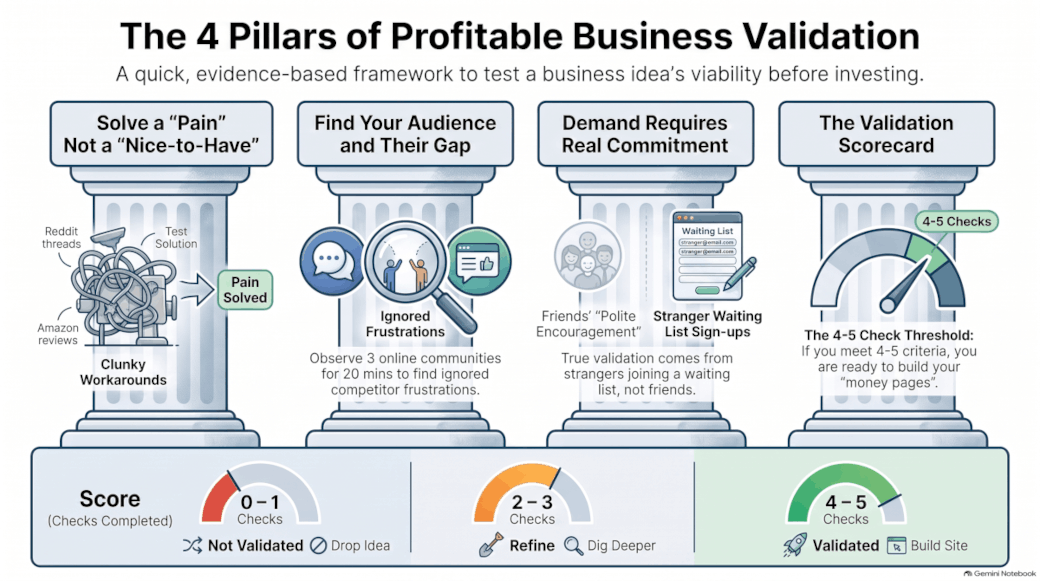
The four pillars of business idea validation are a quick, evidence-based way to test an idea before you build anything.
Check One: Is This a Real Problem?
The first item on any business idea validation checklist is the problem itself. There’s a big difference between a “nice-to-have” and a problem people are actively trying to solve. Real problems leave evidence behind, because people complain about them, search for answers and pay for imperfect workarounds.
Do this now: Write down the problem your idea solves in one sentence. After that, write a second sentence describing what people currently do about it. That might be a clunky workaround, a spreadsheet, or simply putting up with it.
If you can’t write that second sentence, pay attention. It doesn’t mean the idea is dead. However, it does mean you only have a hunch so far, not evidence.
Where to look for evidence:
- Reddit and niche forums. Search for the problem in plain, everyday language, not the polished way you’d pitch it.
- Facebook Groups. Look for groups built around your topic or your audience.
- Amazon reviews. Check products loosely related to your idea, especially the 3-star reviews. That’s where people write “I like this, but I wish it also did…”
- Google autocomplete and “People also ask”. Type the start of the problem into Google and see how it finishes the phrase.
Remember, you’re not looking for people discussing your idea. Instead, you’re looking for people describing the problem in their own words, without being prompted.
Check Two: Does an Audience Actually Exist?
A real problem only matters if you can reach the people who have it. So the second item on this business idea validation checklist is finding your audience and getting a rough sense of its size.
Do this now: Pick three places where your audience already gathers, such as a subreddit, a Facebook group, a hashtag or a forum. Then spend twenty minutes reading real conversations there. Don’t search for your idea. Just notice what people are frustrated about, asking for and recommending to each other.
Next, use a few free tools to gauge the scale:
- Google Trends: Is interest in the topic flat, growing or shrinking over time?
- Google Keyword Planner: Roughly how many people search for the problem or the solution each month?
- Simple counting: How many members does that Facebook group have? How active is the subreddit, and how many replies does a typical thread get?
By the end of this check, you should be able to describe your audience in one sentence. That sentence covers who they are, what they struggle with and where they spend time online. Once you can write it, you’ve also chosen your niche, based on real people rather than a category picked from a list.
Check Three: Who Else Is Already Solving This?
It’s tempting to see competitors as bad news, but they’re usually the opposite. In fact, finding no competition at all is often a red flag. More often than not, it means there’s no real market, rather than a gap nobody else has spotted.
Do this now: Find three competitors, either direct or indirect. For each one, answer three questions:
- What do they charge?
- What do customers complain about in their reviews?
- What are they clearly not doing well?
You’re not trying to copy them. Rather, you’re looking for the gap: the thing their customers keep asking for that nobody delivers. That gap is often exactly where your idea fits.
As a bonus, their prices give you a useful benchmark for the next check. For example, if similar solutions sell for $20 a month, you have a realistic idea of what your audience already expects to pay.
Check Four: Would People Actually Pay for It?
This is the hardest check, and the one people skip most often. That’s because it’s the check most likely to kill an idea you’ve grown attached to. Interest is not the same as willingness to pay, and a friend saying “That’s a great idea!” means almost nothing.
This is also where my own mistake comes in. Before you go any further, decide how you’ll make money and what exactly you’ll sell. Plan your money pages first, then build your content around them. It sounds obvious, I know, but at the time it wasn’t obvious to me.
Do this now, and pick one:
- Post about the problem in a relevant community. Then watch the reaction. Likes don’t count, but comments like “When can I buy this?” or “Where do I sign up?” do.
- Build a simple “coming soon” landing page. Describe your solution and see whether anyone joins a waiting list.
- Ask 5–10 people in your target audience directly. Find out whether they’d pay and how much, and be sceptical of a polite “Yeah, I’d probably use that.”
Above all, watch out for praise from friends and family. They aren’t lying, but they’re not your market either, and their opinion costs them nothing. Strangers joining a waiting list or naming a price are the evidence that really counts.
For the full process, including customer interviews, landing pages and when to build an MVP, read our step-by-step guide on how to validate a business idea.
Score Your Idea: The Validation Checklist Scorecard
Your Validation Scorecard
Go through this list honestly. Click each one you can genuinely say yes to.
5–6 ticked: You’ve done the work. Move on to choosing a domain and setting up your site.
3–4 ticked: Don’t scrap the idea yet. Instead, go back to the unticked items and dig a little deeper before you build anything.
0–2 ticked: Your idea isn’t validated yet, and that’s completely fine. It’s far better to find that out now, in an afternoon of research, than six months into building something nobody wants.
Quick Recap
- Prove the problem is real by finding people who describe it in their own words.
- Confirm your audience exists by checking where it gathers and whether interest is growing.
- Study three competitors to find the gap your idea can fill.
- Test whether strangers will pay, and decide exactly what you’ll sell.
- Score your idea, then move forward, refine it or start again.
Frequently Asked Questions
What should a business idea validation checklist include?
A good checklist covers four areas: whether the problem is real, whether a reachable audience exists, what competitors already offer and whether people will pay. In addition, it should ask whether you know how the business will make money, because validation means little without a clear offer.
How do I know if my business idea is good?
Your idea is good when you have evidence, not just enthusiasm. For example, strangers describe the problem without prompting, competitors already earn money nearby and people take real action, such as joining a waitlist. Praise from friends and family doesn’t count. Instead, a business idea validation checklist like this one is the quickest way to gather real evidence.
How long does it take to validate a business idea?
The research checks in this article usually take an afternoon or two. Testing willingness to pay takes longer, though, because you need time for people to respond to a post or landing page. A week or two is realistic for a first answer.
Can I validate a business idea for free?
Yes. Reddit, Facebook Groups, Amazon reviews, Google Trends and Google Keyword Planner are all free to use. Similarly, you can build a basic landing page with a free plan on most website builders. The main cost is your time.
Is no competition a good or bad sign?
Usually, it’s a bad sign. A lack of competitors more often means there’s no market than a hidden gap. Competitors prove that people already spend money on the problem, so your job is to find what they do badly.
What should I do if my idea fails the checklist?
First, look at which items you couldn’t tick. A weak audience or no proof of payment can often be fixed by narrowing your niche or changing your offer. If the problem itself isn’t real, however, it’s better to move on to your next idea.
Whats Next:
Now that you’ve completed the business idea validation checklist, does your idea stack up? If it does, the next step is choosing a domain, which is the first part of getting your site set up. After that, you can start planning the money pages that turn your validated idea into income.
