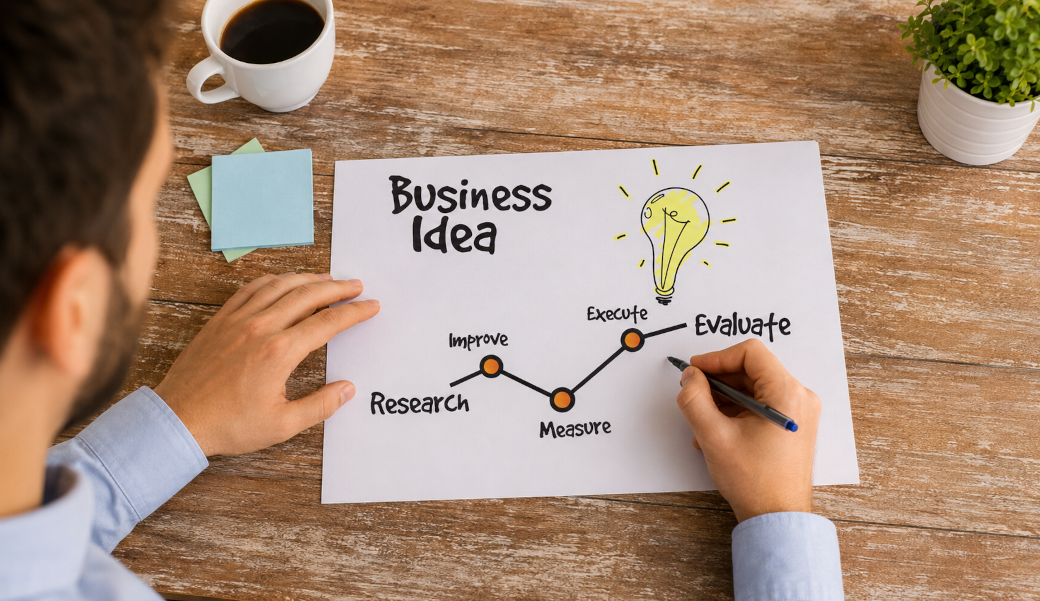
How to Validate a Business Idea Before You Spend a Single Dollar Building It
Before you write a line of code or spend a cent on inventory, it is so ,so important to validate a business idea.
You need to know if anyone actually wants what you’re planning to sell. Here’s the number that should stop you in your tracks: 42% of startups fail simply because there is no market need for their product. That’s not a funding problem or a marketing problem. That’s a business idea validation problem, and it’s completely avoidable.
We’ve watched founders pour months into building something nobody asked for. We want to change that. This guide walks you through exactly how to validate a business idea, step by step, using the same practical approach we recommend to everyone who lands on our I Have an Idea page.
Key Takeaways
| Question | Quick Answer |
|---|---|
| What is business idea validation? | The process of testing demand for your product or service before you build it, using real feedback from real people. |
| How to test a business idea cheaply? | Start with a landing page, a short survey, and direct conversations. No coding or inventory required. |
| How long does market validation take? | Anywhere from a single afternoon with the right tools to a few weeks for deeper customer interviews. |
| Do I need an MVP to validate a business idea? | Not always. Many ideas can be validated with a demo video, a waitlist, or a pre-order page first. |
| What’s the biggest validation mistake? | Asking friends and family for opinions instead of asking strangers for money or commitment. |
| What comes after validation? | Once demand is proven, you move toward building and getting ready to monetise your idea. |
| Is market validation still relevant with AI tools? | Yes, and AI now speeds up the research phase considerably, though it should support your judgment, not replace it. |
What Does It Mean to Validate a Business Idea?
To validate a business idea means proving, with evidence, that real people want what you’re planning to offer, before you invest serious time or money into building it.
That’s it. No hype, no guesswork, no “trust the vision” mentality.
We believe building an online business isn’t about chasing quick wins or acting on gut feeling alone. It’s about creating something real, something people actually need. Validation is how you find out if that’s true before it costs you anything meaningful.
Why Market Validation Matters More Than a Great Idea
Every founder thinks their idea is good. That’s not the question.
The question is whether strangers, people with no reason to be polite to you, will pay for it, sign up for it, or actively seek it out. Market validation answers that question with data instead of optimism.
Founders who skip this step and go straight to building tend to learn the hard way. Founders who validate first tend to move faster, spend less, and pivot earlier if something isn’t working.
Step 1: How to Test a Business Idea With Real Conversations
“Before you book any conversations, run your idea through our business idea validation checklist. It takes an afternoon, and it tells you exactly who you should be talking to.”
The cheapest, fastest way to test a business idea is to simply talk to people. Not your family. Not your friends who love you unconditionally. Strangers who fit your target customer profile.
Research recommends conducting between 25 and 50 unbiased primary interviews to gather enough qualitative data to spot real patterns. That sounds like a lot, but most of these conversations take fifteen minutes.
Ask about their problems, not your solution. If you pitch your idea too early, people will be polite and say “that sounds nice.” Politeness isn’t validation.
Instead, ask:
- What’s the most frustrating part of [the problem your idea solves]?
- What have you tried already to fix it?
- What would you pay to make this problem disappear?
Step 2: Build a Landing Page to Validate a Business Idea Before You Build the Product
A simple landing page describing your product, with an email signup or a “buy now” button that doesn’t actually charge anyone yet, is one of the most effective early tests available.
It’s also dramatically cheaper than pivoting after launch. Testing demand this way, before development, is roughly 85% less expensive than discovering the same information after the product is already live.
Dropbox is the classic example here. A three-minute demo video, no working product behind it, generated 75,000 signups overnight. That’s what proof of demand looks like, and it cost almost nothing to produce.
When you’re ready to put a page like this together, our website launch checklist walks through exactly what needs to be in place before you publish it.
Step 3: Use an MVP to Validate a Business Idea With Real Users
If conversations and a landing page suggest real demand, the next step is a minimum viable product, the simplest version of your idea that still solves the core problem.
This doesn’t need to be polished. It needs to work well enough for real people to use it and give you honest feedback.
Building an MVP or prototype to test solutions with actual users can reduce total development costs by 30 to 50 percent, because you’re only building what’s necessary to prove the concept, not the finished, feature-heavy version.
Fundamentals remain the same whether you’re building with AI tools or by hand: solve one real problem, test it with real users, and let their feedback guide what you build next.
Step 4: Look for Proof, Not Just Praise
Compliments don’t pay bills. Commitment does.
Real proof of market validation looks like:
- People giving you their email address to join a waitlist
- Strangers pre-ordering before the product exists
- Repeat visits to your landing page or demo
- People asking “when can I actually buy this?”
Praise without action is noise. Filter it out and focus on the signals that show someone is willing to spend money, time, or attention on what you’re building.
It’s worth remembering that 68% of successful startups, including several unicorns, conducted extensive customer research before launch. That’s not a coincidence. That’s the pattern.
Step 5: Use Tools to Speed Up Business Idea Validation
Technology, especially AI, is changing how quickly you can validate a business idea. What used to take weeks of manual market research can now be compressed into a single afternoon using AI-powered demand-signalling frameworks.
But AI is a tool, not a replacement for creativity, experience or good judgement. It can help you spot patterns faster. It can’t tell you whether your gut is right about a customer you’ve actually spoken to.
A few practical tools worth using during this stage:
- Our AI prompt library for generating customer interview questions and survey drafts quickly
- Our business name generator once you’ve confirmed there’s demand and you’re ready to move forward
- Our domain name ideas tool to lock in your web presence before someone else does
- Our profit margin calculator to sanity-check the numbers behind your idea before you commit
Taking time to test demand early pays off in accelerated revenue later.
Common Mistakes People Make When They Try to Validate a Business Idea
We see the same mistakes over and over. They’re easy to avoid once you know what to watch for.
Asking people you love for their honest opinion rarely produces an honest opinion.
Other frequent mistakes include:
- Skipping the interview stage entirely and jumping straight to building
- Treating “likes” as validation instead of looking for actual payment or commitment
- Building too much too soon, before confirming anyone wants the core solution
- Ignoring negative feedback because it doesn’t match the vision you already had in your head
- Validating once and stopping, when market validation should be an ongoing habit, not a one-time checkbox
Work smarter, not harder. Validation done right saves you from these mistakes before they cost you real money.
What Happens After You Validate a Business Idea?
Founders who validate their idea properly before building save an average of $50,000 or more compared to those who go straight to full development. That’s money you get to keep, or reinvest into growth instead of into fixing a product nobody wanted.
Once you’ve confirmed real demand, it’s time to move forward with confidence. Our getting started guide covers what comes next, from building your first offer to preparing for launch.
From there, you’ll want to look at monetising your idea properly, and eventually at how to scale your business once revenue starts coming in consistently.
Structured validation frameworks also tend to get founders to market roughly twice as fast as those working without one. Speed matters, but only once you know you’re building the right thing.
Conclusion: Validate a Business Idea Before You Build, Not After
Learning how to validate a business idea isn’t a side step on your way to building something great. It is the foundation everything else stands on.
One conversation. One landing page. One honest look at whether strangers are willing to commit. One step at a time; that’s how real businesses get built.
We believe every founder deserves trusted advice and practical strategies, not hype, when they’re deciding whether to move forward. If you’ve validated demand and you’re ready for the next stage, our start here page is exactly where to go.
Frequently Asked Questions
How do I validate a business idea with no money?
Talk to potential customers directly, build a free landing page with a signup form, and post about your idea in relevant online communities to gauge reaction. All of this costs nothing but time, and it’s enough to validate a business idea before spending a dollar on development.
What is the fastest way to test a business idea?
A landing page with a clear offer and a signup or pre-order button, paired with a short demo video, is the fastest way to test a business idea. AI-powered research tools can now compress what used to take weeks into a single afternoon of focused work.
How many people should I talk to for market validation?
Most founders need somewhere between 25 and 50 unbiased customer interviews to spot reliable patterns in what people actually want. Fewer than that and you risk concluding a small, unrepresentative sample.
Do I need an MVP before I validate a business idea?
Not necessarily. Many successful ideas were validated with a demo video, a waitlist, or a landing page before any product existed, and an MVP only comes after that early demand is confirmed.
Is market validation still necessary in 2026 with so many AI tools available?
Yes, and it’s arguably more important now, because AI tools have made it faster and cheaper than ever to run proper validation before building. AI can speed up the research, but it’s still a tool, not a replacement for talking to real customers.
What’s the biggest sign my business idea is validated?
Strangers taking real action, joining a waitlist, pre-ordering, or paying a deposit is the clearest sign your business idea is validated. Compliments and “that’s a great idea” comments from friends don’t count as proof of demand.
What should I do after I validate a business idea?
Once you’ve confirmed genuine demand, move into building your minimum viable product and start planning how you’ll monetise and grow the business. Skipping straight to scaling without this groundwork is one of the most common reasons early businesses stall.
