
Choosing Your Domain Name Feels Like a Small Decision. It Isn't.
Most people treat picking a domain name like picking a username: a quick decision made in ten minutes, late at night, while everything else about the website feels more important. Then, a year or two later, they regret it.
Sometimes it’s a spelling nobody can guess correctly. Sometimes it’s a name so long that giving out an email address feels like an apology. And sometimes the expensive version of this mistake is a rebrand, months or years in, which means losing search rankings, breaking old links, and starting from zero with some of your traffic.
This guide covers everything I’d actually want someone to know before they buy a domain not just the naming rules everyone repeats, but the parts people usually only learn the hard way: protecting the name once you’ve got it, avoiding registrar pricing traps, and what actually to do when the name you want is already taken.
Start With Purpose, Not the Name
Before you open a domain search tool, answer one question honestly: why does this website exist?
That sounds obvious, but it changes everything about what a good name looks like:
- A personal brand or freelance business usually works best with your actual name
- A niche content site or blog benefits from a name tied to the topic, not just your own identity
- A product or service business needs a name that can grow with you not one so narrow it becomes a problem the moment you expand
Skipping this step is how people end up with domains that describe today’s plan perfectly and next year’s plan not at all. Decide what the site is actually about first. The name should follow from that, not the other way around.
The Core Rules to Choosing Your Domain Name and Why They Actually Matter
You’ll see versions of these rules everywhere. What’s usually missing is why they matter, which is the part that helps you make good judgement calls when a rule doesn’t cleanly apply.
Keep it short. Not as a vanity metric because every extra syllable is something someone has to remember, type correctly, or repeat over the phone. If you wouldn’t want to say your future email address out loud to a stranger, it’s too long.
Make it easy to spell without explanation. If you ever catch yourself saying “no, it’s not enterprise, it’s spelled without the H” out loud, that’s your answer. A name you have to explain is a name that quietly leaks traffic every single time someone tries to type it from memory and gets it wrong.
Avoid hyphens and numbers. Two people telling each other your domain over voice will almost never agree on where the hyphen goes, or whether “4” means the word “four,” the digit, or the letter “for.” It’s not a strict rule sometimes a hyphen genuinely is the only way to get a name that would otherwise be taken but treat it as a last resort, not a starting option.
Say it out loud before you buy it. This is the cheapest test you’ll ever run, and the most skipped. Read the domain out loud, exactly as you’d say it to a new customer on a phone call. If it’s awkward, confusing, or sounds like a different word entirely, you’ll find out now for free instead of finding out in six months from a confused customer.
.com vs. Everything Else
.com is still the most recognised and most trusted extension, and if it’s available for the name you actually want, take it.
But it’s no longer the only sensible option, and treating it as mandatory can push you toward a worse name just to keep the extension. A few realistic alternatives:
- .co a clean, widely accepted shorthand, especially for startups and modern brands
- Country-specific extensions (.co.uk, .ca, .com.au): genuinely useful if your business is deliberately local or regional
- Topic-relevant extensions (.blog, .store, .studio): can work well and even add a little clarity, as long as they’re used deliberately, not as a fallback because .com was gone
The SEO difference between .com and a well-chosen alternative is minimal today. What actually matters more is whether the name is easy to remember and easy to type correctly which loops back to the core rules above.
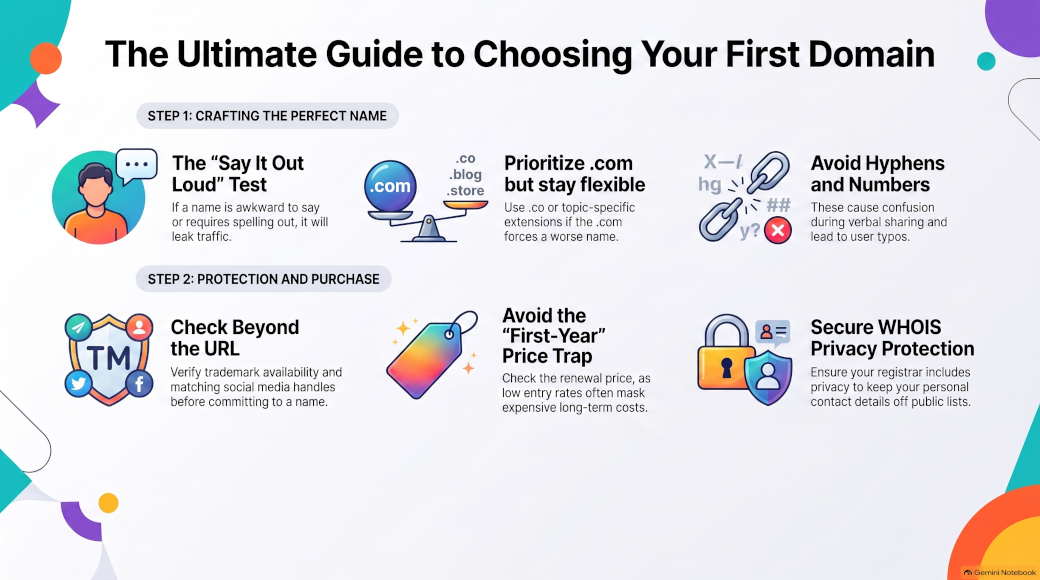
"The Ultimate Guide to Choosing Your First Domain crafting a name that works, then protecting and purchasing it the right way."
Protecting Your Brand
Buying the domain isn’t the finish line it’s the start of making sure the name is actually yours to build on.
Check for trademark conflicts first. A name being available to register doesn’t mean it’s free of legal risk. A quick trademark search before you commit can save you a rebrand later this matters more the more serious the business is.
Check the matching social media handles. A domain and a completely different set of social handles is confusing for anyone trying to find and follow you consistently. Check availability across the platforms that matter to your business before you fall in love with the domain name.
Consider buying your own common misspellings. If there’s an obvious way people might mistype your domain, registering that version too (and redirecting it) is cheap insurance against losing visitors to a typo.
Register a small number of relevant extensions defensively. You don’t need every extension that exists. But owning the .com and your country-specific extension, redirecting one to the other, is a reasonable, low-cost way to stop someone else from sitting on a confusingly similar address.
Choosing Who to Buy Your Domain from Without Getting Stung
This is the part almost nobody warns you about, and it’s where I’d want to save someone real money based on experience, not theory.
The difference between this article and most other you will read on this subject, is that this one is independent, meaning no sponsorship involved, and no affiliate links.
Most other articles are very often sponsored by a company selling domain names, or an affiliate of that company. Their aim being to direct you to the said company, after telling you how wonderful they are.
So here are a few things worth checking with any registrar, domain company before you commit:
- The renewal price, not just the first-year price. A cheap first year followed by a much higher renewal rate is one of the most common ways people overpay without realising it.
- Whether WHOIS privacy protection is included or an extra cost. Without it, your personal contact details can be publicly listed against the domain.
- How easy it is to transfer the domain away later, if you ever need to. Some registrars make this deliberately awkward.
If the Name You Want Is Already Taken
This happens to almost everyone eventually, and it doesn’t have to mean starting over. Work through this in order:
- Can you shorten or simplify it? Sometimes a slightly trimmed version of your original idea is available and just as strong.
- Would a different extension genuinely work? Not as a consolation prize only if it still passes the core rules above.
- Is the current owner reachable? A free WHOIS lookup can show you who owns it. Some domains are genuinely for sale; most aren’t actively used at all.
- Is it worth walking away from entirely? Sometimes the healthiest move is accepting that a specific name isn’t available and choosing a genuinely different one, rather than forcing an awkward variation just to keep the original idea alive.
- Can it be abbreviated? This is the option almost nobody talks about, and it’s exactly how this site got its name. YOB247 started as an abbreviation YOB for “Your Online Business.” I originally wanted just YOB.com, but it was already taken, so I added 247, for 24 hours, 7 days a week. The full version, YourOnlineBusiness.com, wasn’t available either and even if it had been, it falls straight back into the “too long” problem from earlier.There was one more layer to it. According to the Cambridge Dictionary, “yob” is British slang for a young man who behaves in a rude, offensive, and sometimes violent way. Part of me liked that. It’s unexpected, a little cheeky, and exactly the kind of thing that makes a name stick in someone’s memory rather than sliding past unnoticed.Two things worth taking from this: an abbreviation can rescue a name that’s already gone as a full phrase, and a name with a bit of unexpected personality behind it can be more memorable than a perfectly safe, forgettable one.
Still Stuck on Choosing Your Domain Name? Use a Generator
If you’ve worked through all of this and you’re still staring at a blank search box, that’s completely normal naming something is hard, especially when you’re too close to your own idea to see it clearly.
Our free Domain Name Ideas generator takes a keyword and gives you instant combinations across the extensions you’re considering a genuinely useful starting point when you need to see options rather than stare at an empty box.
Your Domain Name Checklist
Before you hit “buy,” go through this list honestly:
- It’s short enough to say out loud without feeling awkward
- Nobody would need it spelled out for them
- It avoids hyphens and numbers (or there’s a genuinely good reason it doesn’t)
- I’ve checked it isn’t already trademarked
- The matching social handles are available, or close enough
- I understand the renewal price, not just the first-year price
- I know whether WHOIS privacy is included
If you can tick all of these, you’re in a strong position to register with confidence. If a few are unticked, that’s worth resolving before you commit not after.
What's Next
Once your domain’s secured, the next stage before you can start building your website is finding the right platform to host your website. Which if you are not careful can be very expensive.
So make sure you read the next article on Hosting Your Website.
