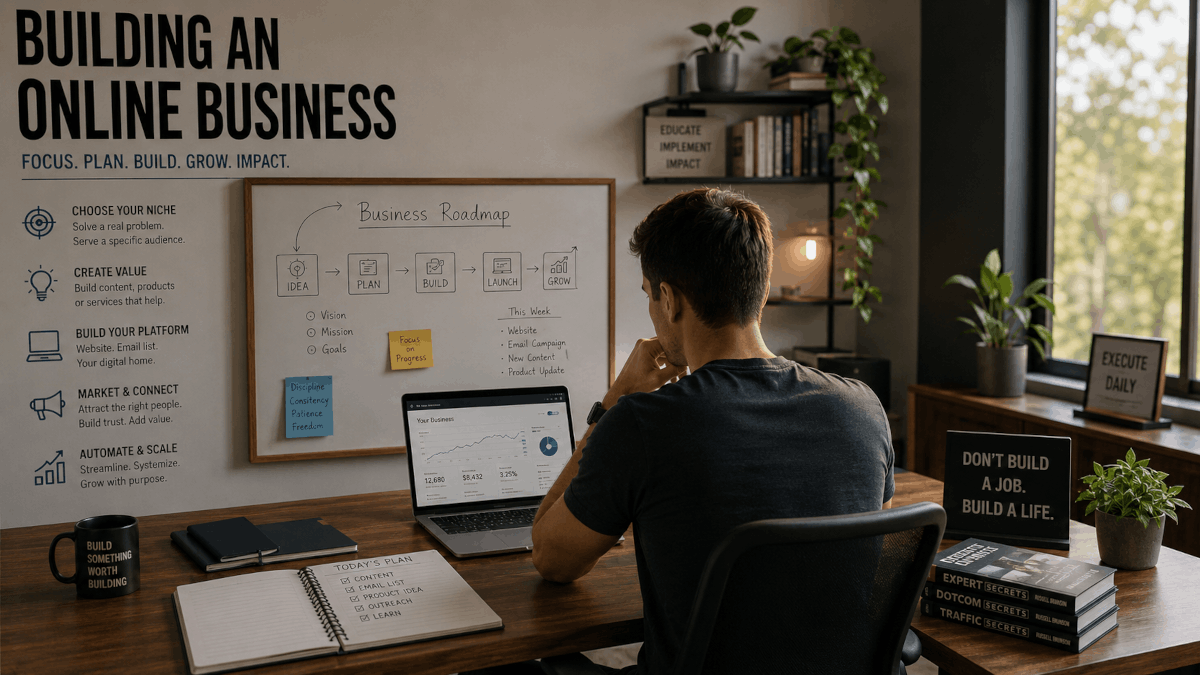
Build an Online Business: The Complete Guide
Starting an online business used to mean big overhead, technical know-how, and a fair amount of risk. That’s no longer the case.
Today, anyone with an internet connection, a bit of patience, and the right roadmap can build an online business from scratch. Very often starting with little more than a laptop and an idea.
In 2018, only 64% of small businesses had a website. Today, that figure is 83%. In other words, going online is no longer a competitive edge it’s the baseline.
When you build an online business now, you’re not up against “the idea” of other businesses going digital. You’re up against real businesses that are already live, already publishing, and already selling.
This guide walks you through exactly how to build an online business, step by step. From finding the right idea to launching and growing it into something sustainable.
Whether you’re testing the waters for the first time or finally ready to commit, you’ll find a clear, practical path forward here.
One built on validation and real value, not shortcuts or “get rich quick” thinking.
Key Takeaways
| What to focus on | Why it matters |
|---|---|
| Validate your idea | Avoid spending your budget building what people don’t actually need. Start with research and proof, not gut feeling. |
| Get the basics online | A simple website, a clear offer, and a plan for content give you a place to earn trust and start converting visitors. |
| Build trust with content | Your audience decides whether to buy based on what they learn from you over time, not from a single sales pitch. |
| Plan monetisation early | Monetisation readiness is value plus alignment if your offer doesn’t match what your audience needs, revenue stays stuck. |
| Use AI as a tool, not a shortcut | AI can speed up research and execution, but it doesn’t replace your judgement, creativity, or experience. |
| Grow steadily | Building an online business isn’t about chasing quick wins. It’s about creating something real and serving customers consistently. |
If you’d rather skip straight to a section, the guide is broken into seven steps below. Idea, validation, business model, foundations, online presence, launch, and growth followed by common mistakes, a 7-day action checklist, and an FAQ.
Why Now Is a Great Time to Start an Online Business (Even as a Beginner)

None of this means building an online business is effortless it still takes real work, consistency, and the willingness to learn as you go.
But if you’re a beginner, you’re not at a disadvantage. You just need a clear process, which is exactly what the rest of this guide gives you.
New AI tools, marketing trends, and “must-have” platforms launch constantly, and a lot of the advice circulating online is outdated, biased, or written mainly to sell you something.
It’s worth cutting through that noise early. However the landscape shifts, a few fundamentals stay constant:
- Clarity: what you offer, and exactly who it’s for.
- Value: proof you can help, not just promises.
- Consistency: publishing, refining, and showing up for customers over time.
- Trust: honest communication and real experience behind what you say.
Those four things matter more than any individual tool or tactic, and they’ll come up again throughout this guide.
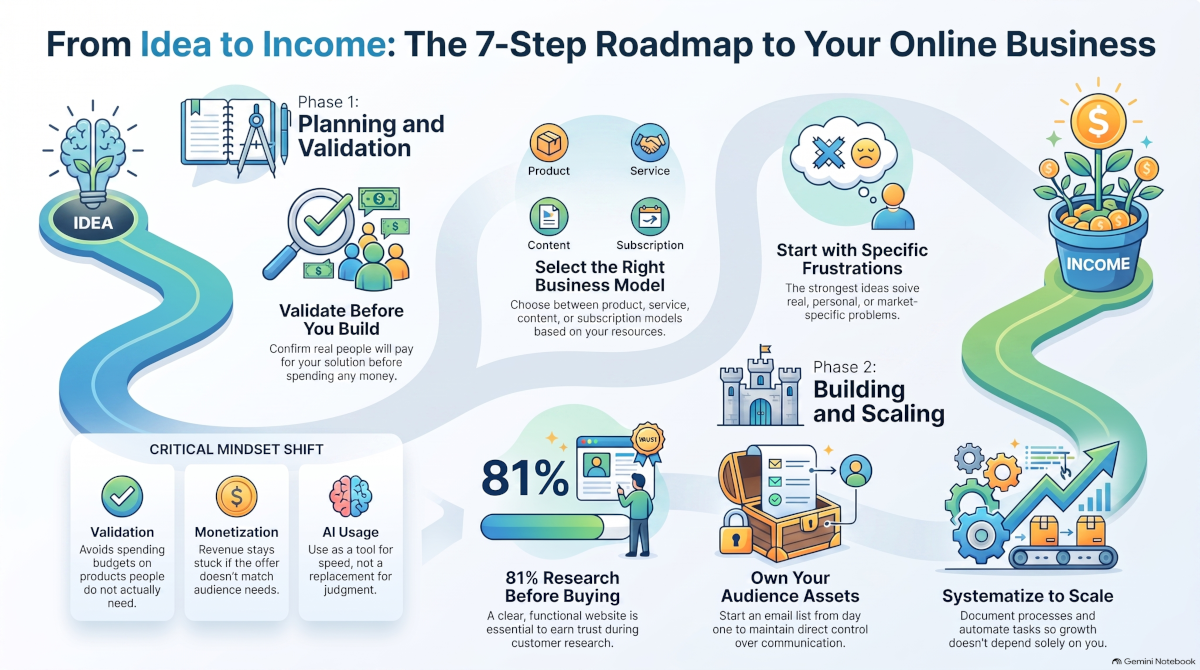
"The 7-step roadmap to building an online business from validating your idea to turning it into steady income."
Step 1: Find the Right Online Business Idea
Every successful online business starts with an idea but not just any idea. The best online business ideas sit at the intersection of three things: something you understand or are willing to learn deeply, something people are actively willing to pay for, and something you can realistically start with the resources you have.
Common categories of online business ideas include:
- E-commerce selling physical products, whether made yourself, sourced wholesale, or drop-shipped
- Digital products templates, courses, e-books, software, or other things people can download or access online
- Services freelancing, consulting, coaching, or agency work delivered remotely
- Content and audience-based businesses blogs, newsletters, or YouTube channels monetised through ads, sponsorships, or products
- Marketplace and subscription models recurring-revenue businesses like membership sites or subscription boxes
When brainstorming, look at three sources: your own skills and interests, problems you’ve personally experienced and wished someone would solve, and gaps you notice in existing markets. The strongest ideas usually come from real, specific frustration either your own or someone else’s.
Don’t aim for a perfect idea at this stage. Aim for a promising one. You’ll test and refine it in the next step.
Step 2: Validate Your Idea Before You Build
This is the step most beginners skip and it’s the one that causes the most wasted time and money later. Before you build a website, register a business, or spend a dollar on inventory, you need to confirm that real people actually want what you’re planning to offer.
Validating your idea means answering a simple question: will people pay for this? You can start finding that answer through methods like:
- Talking directly to potential customers about their problems and current solutions
- Searching for existing competitors their presence is usually a good sign, not a bad one
- Building a simple landing page and measuring interest before the product exists
- Running a small-scale test offer to a limited audience
Validation isn’t a one-time checkbox; it’s a mindset you carry through the early stages of the business. The goal is to get real signals from real people as early and cheaply as possible.
We’ve put together a full walk through of this process in our dedicated guide: How to Validate a Business Idea it’s worth reading in full before you move to the next step, since everything after this point depends on having a validated foundation.
Step 3: Choose Your Online Business Model
Once you have a validated idea, you need to decide how it will actually make money. Your business model shapes almost everything downstream your costs, your time commitment, and how quickly you can grow.
Here’s a quick comparison of the most common models for beginners:
Product-based businesses (physical or digital products) tend to have clear, transactional revenue but often require more upfront investment in inventory or production, and ongoing attention to fulfilment.
Service-based businesses usually have the lowest startup cost and fastest path to your first sale, since you’re monetising skills you already have. The trade-off is that your time is directly tied to your income until you build systems or hire help.
Content and audience-based businesses take longer to generate meaningful revenue but can become highly scalable once an audience is built, since one piece of content can generate income repeatedly over time.
Subscription and membership models offer the most predictable, recurring revenue, but require consistent value delivery to keep subscribers from cancelling.
There’s no universally “best” model only the one that fits your idea, your available time, and how quickly you need to see income. Many successful online businesses actually blend two models over time, starting with services to fund a product, for example.
Step 4: Set Up the Foundations
With your idea validated and your model chosen, it’s time to put the basic infrastructure in place. This step isn’t glamorous, but skipping it creates problems later.
Legal and business structure. Decide whether you’re operating as a sole trader/proprietor or forming a formal business entity. This affects your taxes, liability, and how professional you appear to customers and partners.
Branding basics. You don’t need an elaborate brand identity to start, but you do need a name, a simple logo, and consistent visuals across your website and social channels.
Domain and website platform. Secure a domain name that matches your brand, and choose a website platform suited to your business type an e-commerce platform for product sales, a simple website builder for services, or a publishing platform for content businesses.
Payment processing. Set up a way to actually accept money this is often simpler than people expect, with most website platforms offering built-in payment integrations.
Keep this stage lean. The goal is a functional foundation, not a perfect one. You can and should improve all of this as the business grows.
Step 5: Build Your Online Presence
This is where your business becomes visible to the world. For most beginners, three elements matter most in the early stages:
A clear, functional website. It doesn’t need to be flashy. It needs to explain clearly what you offer, who it’s for, and how someone can buy or get in touch. Confusing websites lose customers before they ever reach your product.
Basic SEO. Search engine optimization helps people find you without you having to constantly chase them down. At minimum, make sure your website has clear page titles, descriptive content, and is structured in a way search engines can easily understand.
One or two social channels not five. It’s tempting to try to be everywhere at once. Resist that urge. Pick one or two platforms where your ideal customers already spend time, and focus your energy there consistently rather than spreading yourself thin across every platform.
An email list, from day one. Of everything on this list, this is the one beginners most regret not starting sooner. Unlike social media followers, your email list is an asset you own and control directly start collecting emails as soon as you have a website, even before you have anything to sell.
Did you know? 81% of shoppers research a business online before making a purchase often reading reviews or checking a website before ever getting in touch. That’s exactly why the presence and clarity of your site matters so much in these early steps.
A quick note on mobile: more of your visitors will land on your site from a phone than a desktop. Make sure your pages load quickly and read clearly on a smaller screen a slow or cluttered mobile experience will cost you customers before they even see what you offer.
Step 6: Launch and Get Your First Customers
Launching isn’t a single moment it’s the start of an ongoing effort to get in front of the right people. Beginners often expect a rush of customers on day one. In reality, most online businesses build momentum gradually.
Focus your early efforts on a small number of channels rather than trying everything at once:
- Organic outreach directly reaching out to your existing network, relevant online communities, and early prospects you identified during validation
- Content marketing publishing helpful content that naturally attracts your target audience over time
- Paid advertising a faster (but costlier) way to get in front of potential customers, best used once you understand what messaging converts
- Partnerships and collaborations teaming up with other businesses or creators who already have access to your target audience
Your first customers matter more than their number. Pay close attention to their feedback it will tell you what to double down on and what to fix before you try to scale.
Step 7: Grow and Scale Your Online Business
Once you have consistent customers and a repeatable process, growth becomes about doing more of what works, more efficiently.
Build systems, not just habits. Document your processes for fulfillment, customer service, and marketing so they don’t rely entirely on your memory or availability.
Automate where it makes sense. Email sequences, scheduling, and basic customer service can often be partially or fully automated, freeing up your time for higher-value work.
Reinvest strategically. Early profits are often best put back into the areas that are already working whether that’s advertising, content production, or product development rather than spread thin across untested ideas.
Know when to bring in help. As demand grows beyond what you can personally handle, delegating or hiring even part-time or through freelancers is often what allows a business to keep growing instead of plateauing.
Scaling isn’t about doing everything faster. It’s about building a business that doesn’t depend entirely on you doing everything yourself.
Common Mistakes to Avoid

One Step At A Time.
A few mistakes come up again and again with beginners building an online business:
- Skipping validation and building something before confirming anyone wants it
- Overbuilding before launching spending months perfecting a website or product instead of getting real feedback early
- Underpricing out of fear of rejection, which undervalues the offer and makes the business harder to sustain
- No clear marketing plan assuming customers will simply find the business on their own
- Trying to do everything at once spreading time and budget across too many channels or ideas instead of focusing on what’s working
Most of these mistakes come from moving too fast in the wrong direction, rather than moving too slowly. A clear process like the one in this guide helps you avoid them.
One more principle worth building in from the start, especially once you begin recommending tools or products to your own audience.
Keep your opinions honest and independent of any commission you might earn. Readers can tell the difference between a genuine recommendation and one written to chase a payout, and that trust once lost is very hard to rebuild.
Your Next 7 Days
If everything above feels like a lot, here’s how to turn it into immediate action. You don’t need to complete every step in this guide before you start; you need to complete these five things:
- Pick one online business idea and validate it with real research, not assumptions.
- Build one core page that clearly explains your offer, who it’s for, and the outcome.
- Create one useful piece of content that answers a real question your future customers have.
- Define your monetisation step: what you want someone to do after they read or visit.
- Choose one task to automate or simplify so admin work doesn’t eat into the time you actually need to build the business.
That’s how you start a business online and keep the momentum going one deliberate step at a time, rather than everything at once.
Frequently Asked Questions
How much does it cost to start an online business?
Costs vary widely by model, but many online businesses can realistically be started for a few hundred dollars or less, particularly service-based or digital product businesses.
E-commerce businesses involving inventory typically require more upfront investment.
How long does it take to build an online business?
Most online businesses take several months of consistent effort before reaching meaningful, reliable income.
Timelines vary depending on the business model, the amount of time invested, and how quickly the idea was validated.
Can I start an online business with no money?
Yes, particularly with service-based or content-based models, where your primary investment is time and skill rather than capital.
Free or low-cost tools make it possible to get started before investing in paid infrastructure.
Do I need technical skills to build an online business?
No. Most modern website builders, e-commerce platforms, and marketing tools are designed for non-technical users.
Willingness to learn matters far more than existing technical expertise.
Can AI help me build an online business without replacing my own judgment?
Yes AI can speed up research, drafting, and day-to-day admin considerably. What it can’t replace is judgment: deciding what your customers actually need, reviewing AI-assisted work before it goes live, and making the calls that shape your brand and reputation.
Use it as a tool that removes friction, not as a substitute for thinking things through yourself.
Final Thoughts

Building an online business is a process, not a single decision. It starts with a validated idea, moves through choosing the right model and foundation, and grows through consistent visibility and steady iteration. There’s no perfect starting point only the next right step.
If you haven’t yet, start with validating your idea using our step-by-step validation guide it’s the foundation everything else in this article builds on.
If You have any questions you can leave them in the comments, and I will get back to you. Or if you prefer you can email me via the contact page.
