
How to Get Traffic to a New Website: 7 Strategies That Work in the AI Search Era
You’ve launched your website, published your first posts, and opened your analytics. The number staring back at you is close to zero. That’s completely normal, but it still hurts, because nobody can buy from a website they never see.
The usual advice is to “do SEO and be patient.” However, SEO on a brand-new domain can take six to twelve months to pay off. Meanwhile, Google now answers many questions directly on the results page, so even a page-one ranking sends fewer visitors than it used to.
This guide shows you how to get traffic to a new website using seven channels you can start this week. If you’d like a bird’s-eye view of every option first, including cost and speed, read our map of traffic sources that actually convert. Then come back here for the step-by-step play book.
Key Takeaways
- Search is now a visibility channel rather than a guaranteed traffic source, so a new website needs more than one way in.
- Platforms Google already trusts, like LinkedIn, Medium, and Reddit, get you seen while your own domain earns trust.
- Free tools and an email list are the two assets AI answers can’t easily replace.
- Rising direct traffic, meaning people typing your name or URL, is the clearest sign your strategy is working.
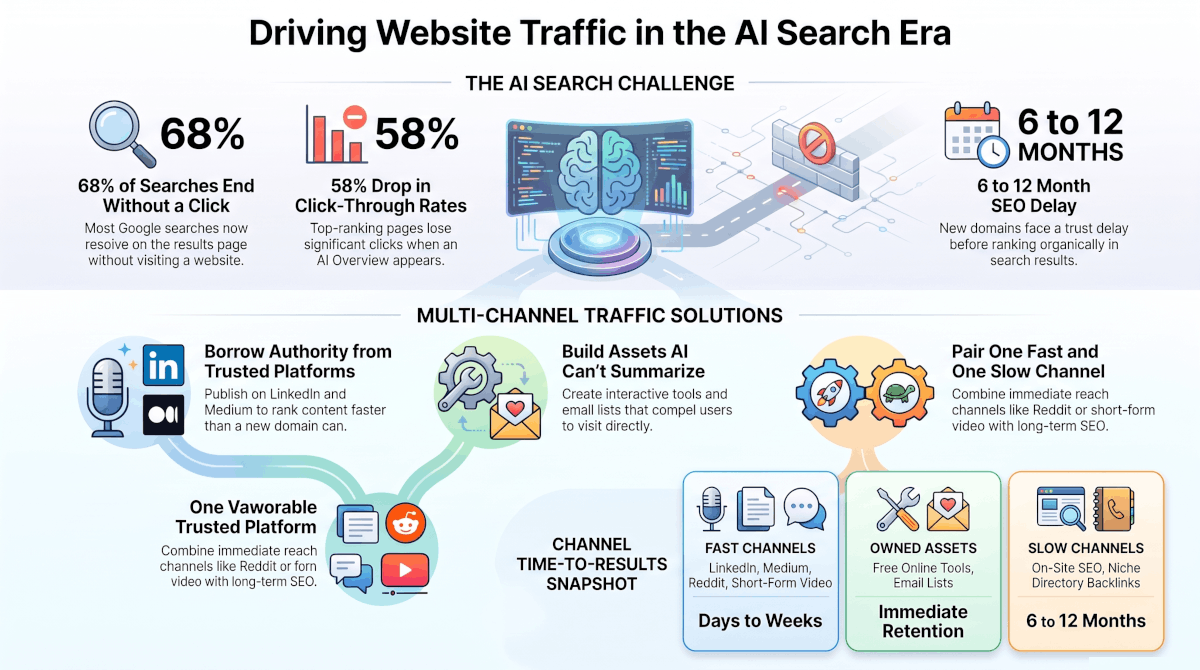
"Why AI search changes the traffic game, and the multi-channel mix that works around it."
Why It's So Hard to Get Traffic to a New Website Right Now
Two things work against you. First, a new domain has no track record. Google tends to hold back fresh sites until they build trust through links, mentions, and consistent publishing. SEO professionals call this the “sandbox effect.” Google has never officially confirmed it, but most new site owners feel it.
Second, fewer searches end in a click at all. According to SparkToro’s 2026 research, about 68% of US Google searches in early 2026 ended without a click. On top of that, Ahrefs found that when an AI Overview appears, the top-ranking page gets a 58% lower click-through rate.
So what does that mean for you? In short, you can’t rely on Google alone, especially in year one. Instead, you need to show up where your audience already spends time. You also need assets that give people a reason to click. The seven strategies below do exactly that.
Strategy 1: Borrow Authority From High-Ranking Platforms
Your domain is new, but LinkedIn and Medium aren’t. Google already trusts these platforms, so an article you publish there can rank months before your own site could. That’s why this is the fastest free way to put your ideas in front of searchers.
Some marketers call this “parasite SEO.” However, that label covers two very different things. Publishing your own useful articles on your own account is perfectly fine. In contrast, paying to place low-quality content on someone else’s big site to exploit its rankings breaks Google’s spam policies. Stick to the first approach.
Choosing Between LinkedIn and Medium
Linking Back Without Looking Like Spam
Target keywords your own site can’t rank for yet. Write a complete, genuinely helpful article, then add one or two links to deeper resources on your website. If you’re republishing a post from your site on Medium, use its import feature, which credits your original. Finally, end with a clear call to action, such as a free checklist or newsletter sign-up. That way, the platform’s reach sends interested readers straight to you.
Strategy 2: Use Community Marketing on Reddit and Quora
People are tired of generic, AI-written answers. As a result, they increasingly look for real experiences from real people, and Google has noticed. It now surfaces forum threads prominently, and it even offers a dedicated “Forums” filter. That makes community marketing one of the best ways to reach people who already care about your topic.
Reddit: Contribute Before You Link
Reddit users spot self-promotion instantly, and most subreddits have strict rules about it. So spend your first few weeks simply helping. Answer questions in detail, share what worked for you, and build a posting history. Later, when a link to your article genuinely answers someone’s question, share it. It also helps to put your website in your profile, since curious readers often click through from there.
Quora: Answer the Questions People Already Ask
Quora works in a similar way. Search for questions in your niche that already get views, then write the most useful answer on the page. Give the full answer first, and only then link to your site for readers who want more depth. One warning, though: don’t post questions just so you can answer them yourself. Quora treats that as manipulation, and it can get your account restricted.
Blog Comments That Actually Get Clicked
Thoughtful comments on popular blogs in your niche can send visitors to you. The keyword here is thoughtful. Add a new insight, a respectful counterpoint, or a quick result from your own experience. Readers who like your comment will often click your name to see who you are.
Strategy 3: Build a Free Online Tool That AI Can't Summarise
An AI Overview can summarise an article in two sentences. However, it can’t run a calculator for you. Free online tools, such as calculators, checkers, and converters, need people to visit and use them. As a result, they keep earning clicks even when AI answers the surrounding questions. Other websites also like linking to useful tools, so they attract backlinks naturally.
Finding Tool Ideas With "Calculator" and "Checker" Keywords
Open Google Keyword Planner and enter your niche topic plus words like “calculator,” “checker,” “generator,” or “template.” For example, a fitness coach might find “macro calculator,” while a freelancer might find “hourly rate calculator.” Then look for terms with steady searches that competitors haven’t covered well.
Building the Tool With AI in an Afternoon
You don’t need to be a developer. Instead, describe the tool to an AI assistant like ChatGPT or Claude and ask it to write the code as a single HTML file. Next, test it, tweak the design, and embed it on a page of your website. Keep it simple, since one tool that works well beats five half-finished ones.
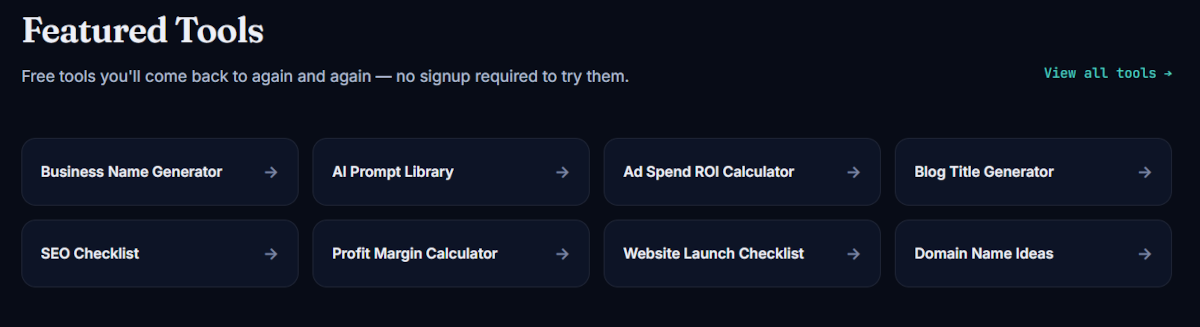
"Our free Featured Tools, built with AI in an afternoon. Try it yourself."
Strategy 4: Drive Traffic With Short-Form Video
Short-form video lets a new website reach thousands of people without any search rankings at all. Better still, one video can work on several platforms at once. Record a 30–60 second clip that teaches one idea from your article, then post it to:
- YouTube Shorts, which can surface your clips in YouTube search.
- TikTok and Instagram Reels, which offer the biggest reach for brand-new accounts.
- Pinterest video pins, which keep sending visitors for months because people save and revisit pins.
Give each platform the same core video with its own caption. Also, end every clip with a clear next step, such as “the full guide is linked in my profile.” That way, viewers who want more know exactly where to go.
Strategy 5: Start SEO on Day One, Even Though It's Slow
Everything so far gets you visitors quickly. Meanwhile, SEO on your own site is the long game, and it’s still worth starting now. Once a page ranks, it can send visitors for years with very little extra work.
Begin with keyword research rather than guesswork. In Google Keyword Planner, check that people actually search for the topics you plan to cover. After that, focus on specific, lower-competition phrases, because a new site rarely wins broad terms. For instance, “email marketing” is out of reach, while “newsletter ideas for coaches” might not be.
It also pays to write about things AI Overviews handle badly. Personal experience, original examples, and detailed comparisons still earn clicks. Finally, expect results to take six to twelve months, and keep publishing through the quiet stretch.
Strategy 6: Own Your Audience With Email List Building

Every channel above is rented. Platforms change their algorithms, and Google changes its results. In contrast, an email list is traffic you own, because you can reach subscribers whenever you publish something new.
Start building your list from the very first visitor. Offer something specific in exchange for an email address, such as a checklist, template, or mini-course. Your free tool from Strategy 3 makes an ideal lead magnet. For example, a mortgage calculator could offer a first-time buyer’s checklist once someone finishes a calculation.
Never buy an email list. Bought lists hurt your deliverability, often break privacy laws, and rarely contain anyone who wants to hear from you. Instead, grow your list slowly with people who chose to join. Then send them each new article, because returning subscribers are some of the most engaged visitors you’ll ever get.
Strategy 7: Earn Referral Traffic From Directories and Partners
Referral traffic comes from links on other websites. Beyond sending visitors directly, these links also boost your SEO because search engines treat them as signals of trust.
Finding Directories Your Competitors Already Use
Start with directories and resource lists in your niche. To find them, look up two or three competitors in a backlink tool and note which directories link to all of them. If they all appear somewhere, you probably belong there too. If you serve customers locally, a Google Business Profile is worth setting up as well.
Pitching Partnerships With Something Useful
Cold emails asking for a guest post usually get ignored. So lead with value instead. Suppose a blogger you follow recommends a tool but mentions that it lacks a feature. If your free tool includes that feature, email them, explain what you built, and ask whether it would help their readers. That pitch solves their problem first, which makes a “yes” far more likely.
How to Tell Your New Website Traffic Is Growing
Total visitors matter, but they don’t tell the whole story. Instead, check which channels send people who stay, read, and subscribe. Then do more of what works and drop what doesn’t.
The strongest signal of all is direct traffic. This means people typing your URL or searching for your brand by name. When that number climbs, people remember you. At that point, you depend far less on any single algorithm, which is the real goal behind all seven strategies.
Quick Recap
- Publish useful articles on LinkedIn or Medium to rank while your domain builds trust.
- Help people on Reddit, Quora, and niche blogs before you share links.
- Build one free tool that answers a real “calculator” or “checker” search.
- Turn each article into a short video for Shorts, TikTok, Reels, and Pinterest.
- Start SEO now with Keyword Planner and specific, low-competition topics.
- Collect emails from day one, using your tool or a checklist as the lead magnet.
- Earn referral links from niche directories and value-first partnerships.
Frequently Asked Questions
How long does it take to get traffic to a new website?
Through SEO alone, it usually takes six to twelve months before you see steady search traffic. However, channels like Reddit, Medium, and short-form video can send your first visitors within days. That’s why it pays to combine fast and slow channels from the start.
Can you get traffic to a new website without SEO?
Yes. Community marketing, short-form video, partnerships, email, and paid ads all send visitors without search rankings. Still, SEO is worth starting early, because it keeps paying off long after you publish.
Is Reddit good for driving traffic to a new website?
It can be excellent, but only if you give value first. Read each subreddit’s rules, answer questions properly, and share links only when they genuinely help. Otherwise, moderators will remove your posts, and users will downvote them.
Is parasite SEO safe?
It depends on what you mean by it. Publishing your own quality articles on LinkedIn or Medium is safe and common. On the other hand, placing low-value third-party content on a trusted site to exploit its rankings breaks Google’s site reputation abuse policy. In that case, Google can demote or remove those pages from search.
Is it worth paying for ads straight away?
Paid ads are the fastest traffic source, so they can help you test an offer quickly. Even so, start small, and only once you have a page that turns visitors into email subscribers. Otherwise, you’ll pay for clicks that leave and never return.
What is zero-click search?
A zero-click search is one where the user gets an answer on the results page and never visits a website. Because AI Overviews now answer so many questions, zero-click searches keep rising. That’s the main reason new websites need traffic sources beyond Google.
Your Next Step: Pick Two Strategies and Start This Week
You don’t need all seven strategies at once. In fact, trying everything at the same time is the quickest way to burn out and see nothing work. Instead, pick one fast channel and one slow one. For example, pair Reddit or short-form video with SEO on your own site. Then give both a steady 30 days before you judge the results.
So choose your two strategies today, block out time in your calendar, and publish your first piece before the week ends. Every visitor you earn now makes the next one easier to get.
And if you’re still shaping the business behind your website, our tutorial on how to start a one-person business with AI walks you through it step by step.
