
How to Start a One-Person Business with AI
A Step-by-Step Tutorial
Building a one-person business with AI does not require a big team or a big budget. It only requires a phone, an internet connection, and a clear plan you can actually follow.
This tutorial breaks the process into five clear steps: choose a topic, pick a platform, post consistently, find your own voice, and measure the right things. Follow each step in order, and you’ll build real momentum instead of a list of ideas you never tried.
Choosing the right business idea and niche is a vital first step, so if you feel you need more clarity on this first step, you can get more information from the article How to validate your business idea; in fact, it may be worth reading that article first.
Key Takeaways
- Copying proven openers beats inventing your own, since millions of viewers have already voted that they work.
- Consistency beats equipment. A phone and daily posting outperform expensive gear used only occasionally.
- Track your output, not your views, because output is the one thing you fully control early on.
- Your original voice comes from doing and sharing your work, not from waiting until you feel ready.
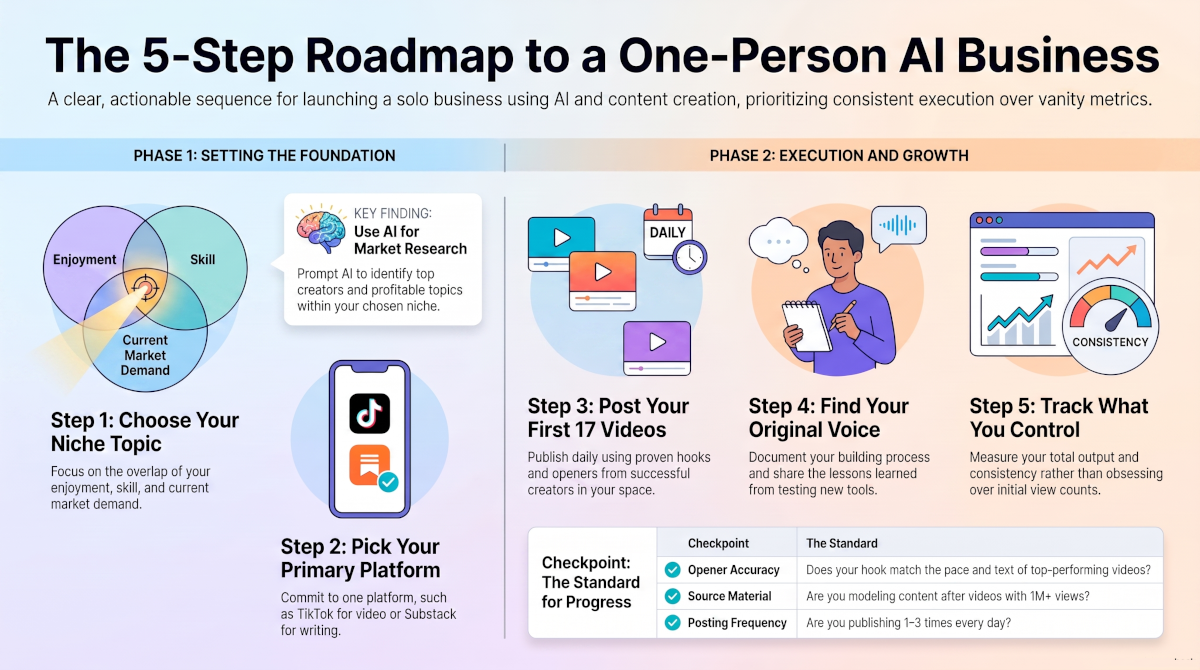
"A quick-glance roadmap for turning AI and content creation into a one-person business save it, then follow the full step-by-step tutorial below."
Step 1: Choose a Topic for Your Personal Brand
Your first job in building your one-person business is to pick a topic, or what marketers call a niche. Popular examples include AI, cooking, fitness, and relationships. Start broad, then narrow the focus once you see what resonates.
Three circles should guide your choice. First, pick something you actually enjoy, because forced content burns you out fast. Second, pick something you are good at, so your advice carries weight. Third, and this is the step most people skip, pick something people already spend money on. AI fits this well right now, since demand for AI skills keeps growing on both the consumer and business side.
The more these three circles overlap, the easier consistency becomes. A topic you enjoy and do well, but nobody pays for, will drain your motivation over time. So aim for all three, even if you don’t nail it on day one.
Use AI Content Creation Prompts to Find Your Topic
Open ChatGPT or Claude and list your skills. Then ask the AI to interview you: what do you enjoy, and what have people already paid or thanked you for? Next, ask it to suggest three topics where people spend money, along with three well-known creators in each space. Always verify that these creators actually exist, since AI tools sometimes invent names.
Once you have your shortlist, search those topics on Instagram or TikTok. Look at what content is going viral and what people are asking about. By the end of this step, you should be able to finish this sentence: “I teach [who] how to do [what].” That one line is your entire topic, so don’t spend more than a few days on it.
Step 2: Pick a Platform TikTok or Faceless Content Creation
Next, for your one-person business is to choose one platform and commit to it. If you’re comfortable showing your face, start on TikTok. Prefer to stay faceless? Start on LinkedIn or Substack instead.
Between those two, Substack is usually the better starting point unless you already have 5,000 to 10,000 LinkedIn connections. Substack rewards new creators with organic growth, while LinkedIn rarely gives traction below that connection count. Fortunately, cross-posting is easy: write your post on Substack, then paste the same text into LinkedIn.
TikTok remains the most generous platform for new creators. Once the platform recognises you as a real person, usually after a few weeks of normal activity, it starts distributing your videos widely. Because so many people find their first win on TikTok within thirty days, it’s a strong choice for anyone willing to appear on camera.
YouTube
Let’s not forget YouTube. Building a successful YouTube channel can be very lucrative. But despite what you might hear, starting a faceless YouTube channel is not the best idea.
Which leaves you with two options. One: build your own Avatar. They are now so advanced it’s almost impossible to tell the difference between an Avatar and a real person.
The second option is to create the Avatar in your likeness. Which a lot of YouTubers are doing. Tools like HeyGen do an incredible job, but there are more and more AI tools coming on the market that will create your own Avatar.
Building a YouTube Channel does take longer, involves more work, and costs money to produce good-quality videos, but if successful, it is worth the investment in the end.
Study the Winning Content
Now put your platform choice to work with a simple four-part system:
- Find your niche’s top creators. Pick three people already succeeding in your topic.
- Sort by their most popular posts, not their average ones. Look for anything that earned roughly ten times more engagement than usual.
- Copy the winning post’s URL and note its opener. The opener covers the first ten seconds of a video, or the first line of a written post.
- Break down what made it work. Weigh the visual, the audio, and the on-screen text together, since strong openers usually combine all three.
An opener that consistently earns hundreds of thousands of views has already proven itself. Later, in Step 3, you’ll copy these proven openers directly, since that’s the fastest way to learn what actually works.
Step 3: Post Your First 17 Videos
Now it’s time to publish. Two fears stop most beginners before they start: needing expensive gear, and worrying what others will think.
Neither should hold you back. A phone camera and an internet connection are enough, and many successful creators went nearly two years without proper lighting or a microphone. As for other people’s opinions, flops usually go unnoticed, and friends rarely engage as much as you’d expect anyway. So post regardless, and let your results speak for themselves.
During this stage, you’ll copy proven openers exactly, then remix your own content inside them. This is not cheating; it’s how most creators build their instincts. Think of it like learning guitar by playing other people’s songs before writing your own.
How to Film a Video
Follow these seven steps for every video:
- Prepare a short script. Take the opener you’re copying, add your own content, then read it aloud and smooth out anything that sounds unnatural. Spend no more than five minutes here.
- Open your platform’s native app. For short-form video, that means TikTok’s own app.
- Turn on the teleprompter feature. Use TikTok’s built-in teleprompter tool so you can read your script while looking at the camera.
- Paste your script into the teleprompter.
- Record in one take, reading the script exactly as written.
- Add an on-screen title once you finish filming.
- Add captions and post. Use the app’s automatic captioning tool, then publish with a short description and three broad hashtags, such as #AI or #ChatGPT.
If you get stuck finding a button, search YouTube or ask ChatGPT or Claude to walk you through it. After a few attempts, the whole process becomes quick.
Set Your Posting Cadence for TikTok Growth
Post once a day at minimum. Three times a day works even better, since each post gives you a fresh data point to learn from before your next video. Even so, daily posting is enough for most beginners, and it keeps the process sustainable.
Expect your first real hit to take 45 to 60 days after you start posting, not overnight. During the first two hours after posting, reply to comments to signal that you’re a real, active person. If a video keeps growing, keep engaging with it; once it plateaus, move on to your next post instead.
Read Your Analytics the Right Way
Ignore the advanced analytics tab for now. Instead, check your profile for any post that performed ten times better than your usual results. For example, if most videos earn 100 views but one earns 1,000, that’s your signal to make more videos like it.
As your baseline grows, so does your next 10x target. Once you consistently hit 1,000 views, look for the next video that reaches 10,000. This single metric matters far more than small day-to-day swings, so resist the urge to obsess over minor differences between videos.
Post Daily Instead of Batching
Avoid batching content into one weekly session while you’re still learning. Daily posting creates a tight feedback loop, since each video teaches you something you can apply to tomorrow’s post. Batching, on the other hand, stretches that feedback loop to a full week, which slows your progress considerably.
Once you’ve built real skill, batching becomes a smart efficiency move. Until then, though, post daily so every video benefits from yesterday’s lesson.
Step 4: Find Your Own Original Voice
By now, copying proven openers has taught you what works. It’s time to build original content using the same instincts.
Follow a simple two-part loop. First, do something: follow a tutorial, test a new tool, or try a new technique yourself. Second, share what happened, including what you attempted, what surprised you, and what you got stuck on. This loop alone can supply endless content ideas, since you’re never short of things to talk about once you’re actively building.
Use AI to Turn Your Work into Content
Try this prompt in ChatGPT or Claude: “My topic is [X]. List 15 small things a beginner could try, test, or build in under 30 minutes, where the result would surprise people.” Do one of these each day, then share what you learned.
For the script itself, try this prompt: “Write a 30-second video script, 70 words max. Start with a scroll-stopping hook. What I did today: [fill in]. What surprised me: [fill in]. Make it casual. Also give me a one-line caption and three broad hashtags.”
This approach keeps you talking only about things you actually understand. As a result, it builds authority naturally and helps you avoid the impostor syndrome that comes from faking expertise you don’t have.
Step 5: Track What Matters as a Solopreneur (ongoing)
Views are the wrong metric early on, mainly because you don’t fully control them yet. Output is what you do control, so track that instead. If you’re posting consistently, you’re already succeeding at this stage.
Content Creator Tips: Troubleshooting No Results Yet
If you’re not seeing results after a few weeks of consistent posting, check three things. First, are you copying the opener exactly, matching the same words, pace, text size, and video length, or only “kind of” copying it? Second, are you using videos with a million-plus views as your source material, rather than smaller posts stuck around 50,000 views? Third, are you posting often enough, ideally three times a day, without long batching gaps between sessions?
Most shortfalls come down to the first point. Put your video next to the original, play both at once, and check honestly whether they match in the first ten seconds. If they don’t, that mismatch is usually the fix you need.
Quick Recap
- Step 1: Choose a topic where enjoyment, skill, and demand overlap.
- Step 2 : Pick one platform and study your niche’s top-performing content.
- Step 3: Film and post 17 videos, copying proven openers exactly.
- Step 4: Start creating original content from your own daily work.
- Step 5: Track your output, not your view count, and troubleshoot with the checklist above if results lag.
Stick to this tutorial one step at a time. You’ll come away with a real body of work, a clearer voice, and the early foundation of a one-person business built with AI.
