Email Marketing Automation: Automating Your First 30 Days of Growth
Email marketing automation is where most new online business journeys either get momentum or stall, because you can’t rely on constant manual emailing. Automated emails generate 320% more revenue than non-automated batch campaigns.
Key Takeaways
| What you’ll do | Why it matters (in 2026) | Your outcome by Day 30 |
|---|---|---|
| Pick one growth goal (leads, sales, or bookings) | Automation works best when the outcome is clear. | A campaign that actually drives revenue. |
| Build your first list with a simple opt-in | A smaller, relevant list beats a large, cold one. | A warm audience you can email repeatedly. |
| Set up automated email marketing (welcome + nurture) | Drip campaigns reduce busywork and keep momentum. | You send once, the system does the follow-up. |
| Track the right signals (clicks, replies, conversions) | Privacy changes mean open rates are less reliable for decisions. | Better improvements, less guessing. |
| Keep content consistent using one simple plan | Consistent content gives your automation something to say. | A content rhythm that feeds automation. |
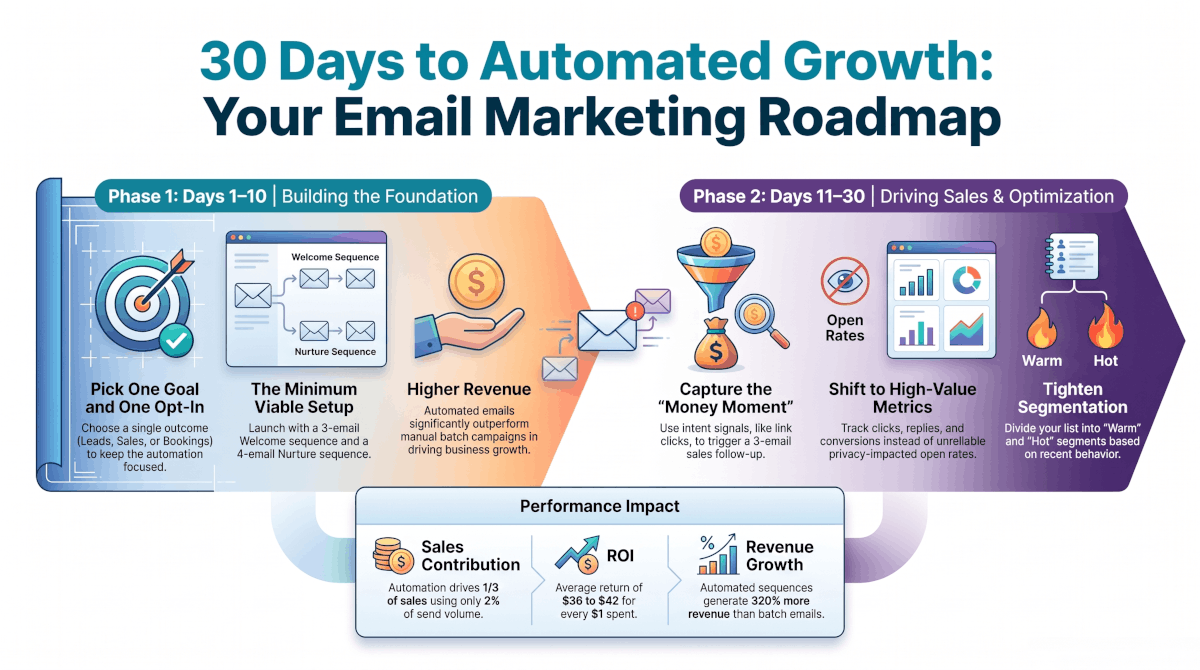
Your 30-day path from first opt-in to a fully automated sequence and the numbers behind why it's worth building.
Why Email Marketing Automation Matters and Why Most People Stall
Building an email marketing automation isn’t about sending more messages. It’s about automating your first 30 days so every new subscriber gets a guided experience from day one.
New tools launch constantly, and everyone promises overnight results. Most of that advice is outdated, biased, or built to sell the next “must-have” platform. The fundamentals haven’t changed: a real online business needs trust, consistent value, and a system that keeps working while you’re busy elsewhere. Automation is how you deliver that without burning out.
Email Marketing Automation is not "set and forget"
Treat it as a loop, not a switch:
- Send a clear message sequence.
- Measure the signals that matter.
- Adjust copy, timing, and offers one step at a time.
AI is a tool, not a replacement for judgement. Use it to handle the repetitive parts, then use your own read on your audience to keep the messages genuine.
Did you know?
Automated email marketing drives more than one-third of all email-generated sales, even though they account for only 2% of total send volume. (Source: CodeCrew)
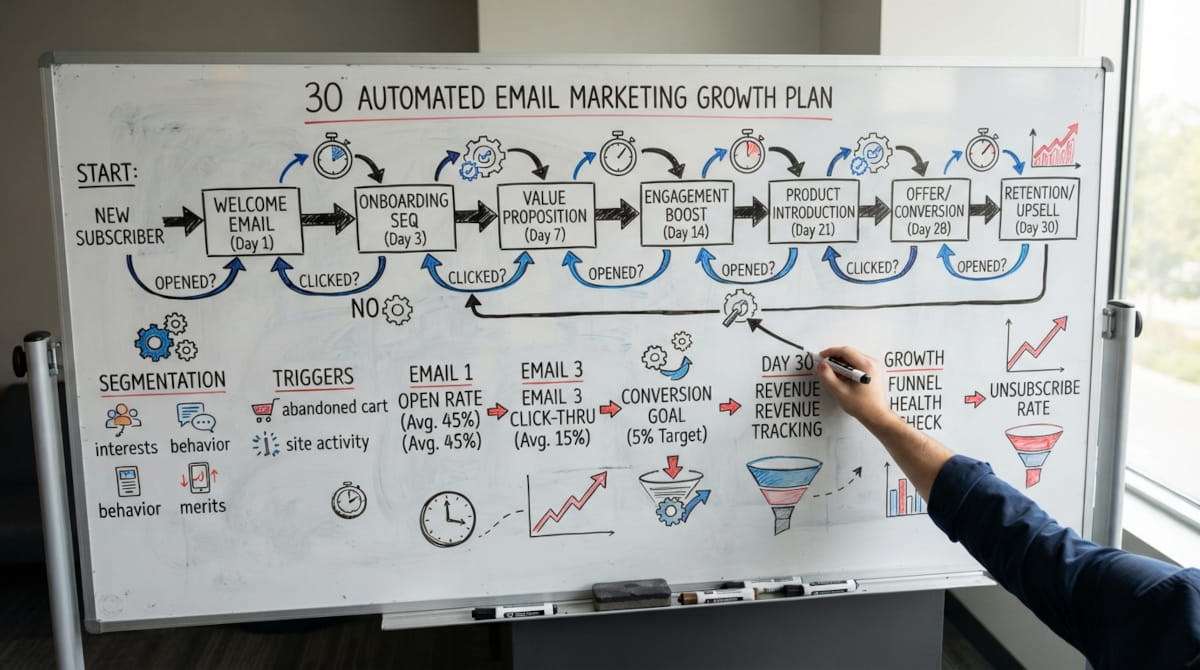
Day 1–3: Build your foundation
Step 1. Choose one outcome
Pick a single target for this 30 days:
- Leads — book calls, request a demo, download a guide
- Sales — promote one core offer
- Bookings — move prospects toward scheduling
Step 2. Create a simple opt-in
One offer. One benefit. One action. Don’t overcomplicate this a focused opt-in converts better than a clever one.
Step 3. Write your welcome email first
Your welcome message should:
- Confirm the opt-in and what happens next.
- Deliver the promised value immediately, or say exactly when it’s coming.
- Tell people what to do next reply, click, or read.
The goal is to serve people, not just capture their attention.
Day 4–10: Set up welcome and nurture automation
Most people rush this step they build a sequence that looks good but doesn’t actually guide anyone. Instead, match your drip campaign to where the reader actually is.
Your minimum viable setup
Two sequences is enough for real learning in your first 30 days:
- Welcome sequence (3 emails): deliver value, build context, invite a next action.
- Nurture sequence (4 emails): teach, remove doubts, introduce your offer softly.
What good automation feels like
- Personal — language that matches your audience’s real questions.
- Useful — one idea per email, one clear point.
- Timed — sent consistently, not constantly.
Keep your message consistent across emails and posts by tying your sequence back to your content plan see Create Content for the backbone of that.
The “vacation responder” mindset
A vacation auto-responder is a promise of continuity send this now, get a reply automatically. Your nurture sequence should carry that same promise through your first 30 days, so the system keeps working even when you’re not at your desk.
Day 11–18: Add the money moment
Now the automation earns its keep. Don’t send everyone the same offer at the same time segment by intent, even simply.
Choose one intent signal
Pick one behaviour that marks someone as more ready than average:
- They clicked a specific link.
- They opened a key email and clicked later.
- They visited an offer page.
Send a short follow-up sequence
A 3-email follow-up built on that signal:
- Email 1: remind them of the result and the fit.
- Email 2: handle objections with a proof point.
- Email 3: a clear call to action buy, book, or respond.
You don’t need a CRM to do this. Mimicking “who did what, and what should happen next” is enough at this stage.
Day 19–24: Improve deliverability without obsessing over opens
Most founders overreact to open rates. Privacy features have made them unreliable for decisions you need better signals.
Track clicks, replies, and conversions
- Click-through — did the email create enough interest to act?
- Replies — are people engaging with your thinking?
- Conversions — are subscribers becoming customers or booked clients?
Make your timing predictable
Choose a schedule you can actually maintain, document it, and iterate based on outcomes not on how you feel that day.
Day 25–30: Turn automation into a system
This is where the project becomes a system: refresh content, tighten segmentation, and lock your next 30-day plan.
Refresh your nurture content
Pick one email in your sequence and improve it based on real behaviour:
- Rewrite the first line to match what people actually clicked.
- Add one concrete example instead of more generic advice.
- Make the call to action specific reply with a question, click to a checklist, or book a time.
Tighten segmentation
Start with two segments:
- Warm — clicked a nurture link recently.
- Hot — clicked the offer link or took an intent action.
Route people accordingly. This is the point where “automated email” becomes automation that actually changes what each person receives.
Plan your next lead source, and keep outreach honest
If you’re layering in cold outreach, be clear about who you are and why you’re emailing. The goal is a conversation, not a spam blast.

Did you know?
Email marketing typically returns about $36 to $42 per dollar spent, often outperforming other digital channels. (Source: Robly)
Quick Recap
- Day 1–3: pick one outcome, build a simple opt-in, write your welcome email.
- Day 4–10: launch a 3-email welcome sequence and a 4-email nurture sequence.
- Day 11–18: add a 3-email, intent-based follow-up sequence.
- Day 19–24: shift tracking from opens to clicks, replies, and conversions.
- Day 25–30: refresh one email, add two segments, and plan your next 30 days.
Frequently Asked Questions
How do I automate my first 30 days of email marketing?
Build one opt-in, then set up a welcome sequence and a nurture sequence. Track clicks, replies, and conversions to decide what to improve next.
What’s the best way to build an email automation sequence for a new business?
Start with a minimum viable setup: 3 welcome emails and 4 nurture emails. That’s enough to learn what your audience actually responds to before you add complexity.
Do open rates still matter for email automation?
Less than they used to privacy changes have made them unreliable. Track clicks, replies, and conversions instead.
How does automated email marketing differ from batch emails?
Automated emails trigger based on behaviour and timing, so the message fits where someone is in their journey. Batch emails go to everyone at once, which usually means lower relevance and weaker performance.
What should a welcome sequence actually include?
Email 1 delivers the promised value and sets expectations. Email 2 builds context. Email 3 invites a next action, like replying or clicking into your best resource.
Is automation alone enough, or do I need segmentation too?
Automation alone usually isn’t enough for long-term growth. Add simple segments and intent-based follow-up for example, based on offer-link clicks once your welcome and nurture flows are running.
How do I plan content for email automation without burning out?
Keep a consistent content rhythm so every email supports an ongoing theme, rather than writing each one from scratch.
Conclusion
Email marketing automation is how you move from “I hope people respond” to “my system follows up for me.” A working welcome flow, a nurture path, and a clear read on what to improve next that’s what 30 days of focused setup gets you.
