
How to Scale a One-Person Business with AI: What to Automate vs. What to Keep Human.

If you’ve covered the basics automating a task or two and keeping an eye on the results the next problem is harder to solve by trial and error. Solo operations aren’t a niche corner of the economy, either: U.S. Census Bureau data show nonemployer businesses made up 78.4% of all U.S. establishments in 2023, so getting this decision right matters to a lot of people, not just you.
The decision is this: which parts of your business are safe to hand off completely, and which ones need to stay yours no matter how good the tools get? Get it wrong in one direction, and you waste your week on things AI could handle. Get it wrong in the other direction, and you lose the trust that made the business work in the first place.
This guide walks through a framework for sorting that out, built around your actual weekly work, not a generic list of “AI use cases.”
Key Takeaways
- Automation only compounds once you’ve proven a process manually. Automating a broken workflow just breaks it faster.
- The real lever isn’t “more AI.” It’s removing decisions that don’t need your specific judgment, so the ones that do get your full attention.
- Two numbers profit margin and your effective hourly return should gate every new automation you add.
- Guardrails, not automation, are what let a one-person business scale without losing the trust that got it there.
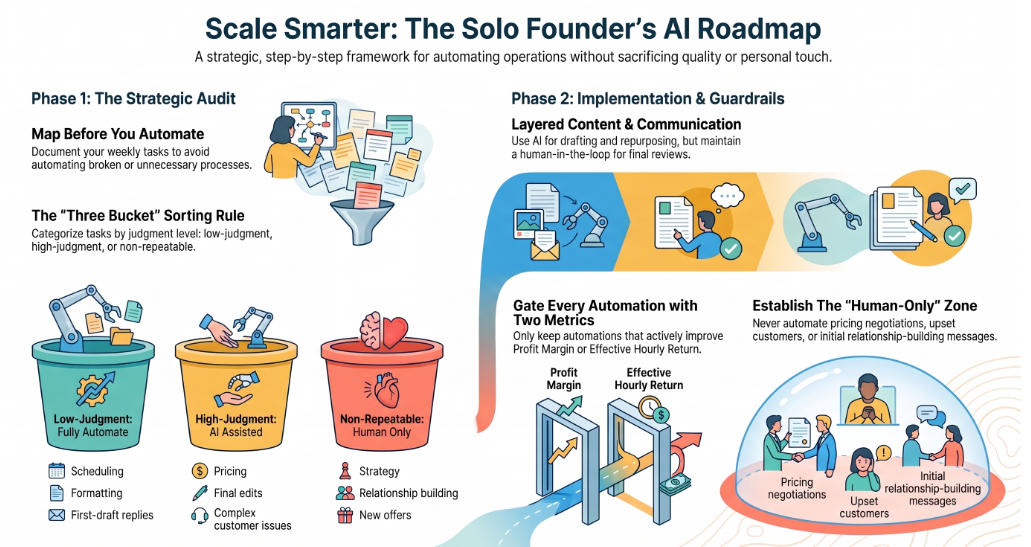
A two-phase roadmap for scaling a one-person business with AI: sort your tasks first, then build in the guardrails that keep the automation trustworthy.
Phase 1: The Strategic Audit
Map Your Weekly Work First
Before you automate anything, write down what you actually do in a normal week. Most solo founders skip this and jump straight to tools, which means they end up automating tasks that shouldn’t exist rather than fixing the process underneath them.
The Three-Bucket Sorting Rule
This is the actual decision framework. Once you’ve got your weekly work listed, sort every task into one of three buckets:
- Repeatable and low-judegment (scheduling, first-draft replies, formatting) — automate these fully. There’s no real decision buried in them, so there’s nothing lost by handing them off.
- Repeatable but judgement-heavy (pricing decisions, final edits, tricky customer situations) — assist with AI, but keep the final call yourself. These are the tasks that look automat-able on the surface but hide a decision underneath.
- Not repeatable (strategy, new offers, relationships) — leave these alone entirely. They don’t happen often enough to be worth systemising, and they’re usually exactly the moments that need your judgement most.
The test that matters isn’t “can AI technically do this?” It’s “what happens the one time it gets this wrong, with no one watching?” That question sorts tasks correctly far more often than asking what’s technically possible.
Phase 2: Implementation and Guardrails
Content and Communication, Layered In
Content is usually the first place solo founders feel the ceiling, because it’s time-consuming and never actually finishes. Use an AI assistant like Claude to draft outlines, repurpose one piece of content into several formats, and generate first-pass copy then edit with your own voice before anything goes out. A saved prompt library built around your own recurring content types makes this step faster every time you repeat it.
Customer communication works the same way, but build it in layers rather than all at once:
- Start with templates for your five most common questions.
- Add AI-drafted follow-ups for leads who’ve gone quiet.
- Only automate a send entirely once you’ve reviewed enough drafts to trust the pattern.
A mistake that reaches one customer is a bad day. A mistake that reaches your whole list because it was fully automated is a bad month. That’s exactly why the review step stays in place until the pattern earns your trust, not just because a tool made it technically possible to skip.
Gate New Additions With Two Metrics
Adding automation without measuring it isn’t progress it’s just doing more of something you haven’t verified pays off. Two numbers matter most for a solo business:
- Profit margin, so you know what you can actually afford to automate or outsource.
- Effective hourly return, so you know whether a task is worth your time or worth handing to AI.
Our profit margin calculator is a quick way to keep this number honest as your costs and pricing shift. If a new automation doesn’t move one of these two numbers within a month or two, it’s not the priority it felt like when you set it up.
A Quick Check Before Anything Ships
Whatever bucket a task lands in, run it past a short checklist before it goes out. Does this match my actual offer and pricing? Does it sound like me rather than a generic AI draft? Would I be comfortable if a customer asked me about it directly? It takes seconds and catches most of what actually goes wrong.
The Human-Only Zone
This is the part most guides skip. Some tasks shouldn’t be automated even once you have the tools to do it: pricing conversations, resolving an upset customer, and any first message to someone you actually want a relationship with. These are exactly the moments where a client can tell whether they’re dealing with a person or a workflow, and it’s the one bucket where “AI-assisted” still means fully human.
The goal was never to remove yourself from the business. It was to remove yourself from the parts that didn’t need you, so you have the time and attention left for the parts that do.
Quick Recap: Scale a One-Person Business with AI
- Map your weekly work before you touch a single tool.
- Sort every task into one of three buckets: automate, assist, or leave alone.
- Layer automation into content and communication gradually, with a review step until you trust it.
- Gate every new automation against profit margin and effective hourly return.
- Run a quick check before anything automated ships.
- Keep pricing, complaints, and first contact fully human permanently, not just while you’re learning.
Frequently Asked Questions
How do I decide what to automate and what to keep human?
Sort tasks by repeatability and judgement. Repeatable, low-judgement work is safe to automate fully. Anything involving pricing, an upset customer, or a new relationship should stay human, no matter how capable the tools get.
What should I automate first as a solo founder?
Start with content drafting and repurposing it’s usually the most time-consuming recurring task and the easiest to hand off safely, since you review everything before it publishes.
Can AI really replace a team for a one-person business?
Not entirely, and it shouldn’t try to. AI can handle drafts, first responses, and repetitive reporting, but decisions that involve pricing, judgement, or customer trust still need you.
How do I know if it’s actually worth keeping?
Check it against your profit margin and effective hourly return after a month or two. If it hasn’t moved either number, it’s probably not worth the added complexity.
Why do some guides say to hand off everything you can?
Because “can this be automated” and “should this be automated” are different questions. Capability doesn’t account for what happens the one time it goes wrong with no one there to catch it that’s a cost, not a technical limitation.
Do I need expensive software to start with this framework?
No. Most of what’s covered here drafting, templates, checklists works with free or low-cost AI tools. Heavier automation platforms only make sense once you’ve outgrown manual templates. If you haven’t automated anything yet, our Beginner’s Guide to Scaling with AI is the place to start.
