
Outsourcing in the Age of AI
Not long ago, growing a business meant finding people to take work off your plate. You hired a freelancer to write product descriptions, a virtual assistant to clear your inbox, or someone overseas to transcribe interviews. Today, a good AI tool can do much of that in minutes.
In fact, researchers at Washington University’s Olin Business School found that writing jobs on Upwork fell by 2% and earnings by 5.2% in the months after ChatGPT launched. Outsourcing in the age of AI hasn’t disappeared, though. Instead, it has changed shape. This guide shows you what to hand to AI, what still belongs with skilled people, and how to keep quality high as your work passes through more tools and more hands.
Key Takeaways
| What you’ll do | Why it matters (in 2026) | What you get |
|---|---|---|
| Audit your outsourcing – before you hire again | Much of what you once paid for is now near-free with AI. | A clear list of tasks to bring back in-house. |
| Sort work into three buckets – AI, AI plus a human, human-led | Fluent AI output isn’t always accurate output. | A simple rule for who handles what. |
| Write one brief – for people and AI alike | Vague briefs cause most quality problems. | Consistent results, whoever does the work. |
| Test before you trust – with small paid trials | Every freelancer now says they use AI, but skill varies widely. | Partners who add real value, not copy-paste. |
| Check work with AI – then add your own judgement | AI spots errors in seconds, so you can focus on what matters. | Faster reviews without lower standards. |
| Guard your voice and data – in writing | Your material travels further than you think. | A business that still sounds like you. |
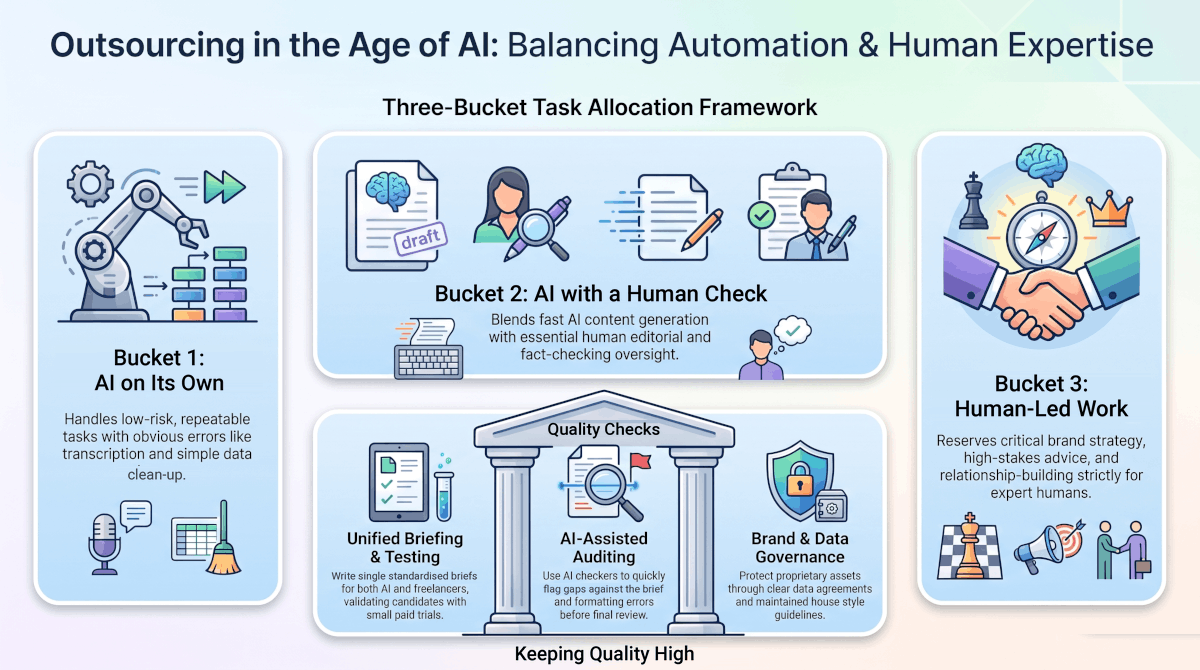
Sort every task into one of three buckets, then keep quality high with clear briefs, AI checks and firm data rules.
Step 1: Audit Your Outsourcing in the Age of AI
Start with an honest look at the work you’ve paid for over the past year. For most creators and businesses, AI can now handle a good share of it in-house. Often, the results match or beat what a budget freelancer delivered.
The usual candidates are first drafts of routine writing, such as product listings, social posts and standard emails. Transcription and meeting notes belong here too, along with basic research, simple data clean-up and quick image variations.
Notice what these tasks share. They follow a pattern; the inputs are clear, and mistakes are easy to spot. That’s the sweet spot for business process automation. So if a task looks like that, try it in-house before you pay someone else.
Step 2: Sort Tasks Into Three Buckets for AI Outsourcing
Next, drop each recurring task into one of three buckets. It’s the simplest rule for outsourcing in the age of AI: decide who, or what, should handle each job.
| Bucket | What it means | Typical examples |
|---|---|---|
| AI on its own | Low-risk, repeatable work where errors are obvious and cheap | Transcripts, meeting notes, resizing images, first-pass data clean-up |
| AI with a human check | AI does the heavy lifting, then a person reviews it | Blog drafts, product descriptions, customer replies, research summaries |
| Human-led | Work that needs expertise, judgement or a relationship | Brand design, legal and financial advice, sales calls, strategy |
Be honest about the third bucket. It’s tempting to push everything towards AI because it’s cheap and fast. However, the human-led bucket is where your reputation lives, so it deserves your best people and your budget.
Step 3: Build Human-in-the-Loop Workflows for the Middle Bucket
The middle bucket is the one most people get wrong. AI output reads well, so it’s tempting to send it straight to customers. But fluent isn’t the same as accurate.
A Harvard Business School study with Boston Consulting Group shows why. Consultants using AI produced over 40% higher-quality work on tasks AI handled well, yet were 19 percentage points less likely to get the right answer on a task outside its strengths. In other words, AI can make good work better and quietly make other work worse.
That’s why human-in-the-loop workflows matter so much for outsourcing in the age of AI. The reviewer doesn’t have to be you, either. For example, a freelancer whose job is to edit and fact-check AI drafts often costs less than a writer. Moreover, the result can beat either one working alone.
Step 4: Write One Brief for AI and Freelancers
Most outsourcing quality problems start with a vague brief. Fortunately, the brief that gets good results from AI also gets good results from a freelancer. So write it once and use it for both.
A useful brief answers five questions. Who is this for, and what should it achieve? Next, what does good look like, ideally with one or two examples? It should also say what the work must never do. Finally, it should explain how you’ll judge whether it’s finished.
Keep these briefs in one place and reuse them. Over time, they become your house style in writing. As a result, you can switch freelancers or move a task between AI and a person without starting from zero.
Step 5: Test Freelancers Before You Commit
Nearly every freelancer now says they use AI. Some use it brilliantly, while others paste your brief into a chatbot and send back whatever appears. When outsourcing in the age of AI, testing is the only reliable way to tell them apart.
First, pick one real task that’s small enough to pay for without worry. Then give the same brief to two or three people, and run it through your own AI tool as well. Finally, compare the results against the standard in your brief.
You’ll learn a lot quickly. For one thing, you’ll see who followed the brief and who added real expertise. The trial also shows whether a person adds enough over the AI version to justify the cost. Still, one good trial isn’t proof, so watch the work for a few weeks before you hand over anything important.
Step 6: Use AI for Outsourcing Quality Control
AI isn’t only something your contractors use. In fact, it’s one of the best tools you have for checking their work.
When a freelancer hands something back, ask an AI tool to compare it against your brief and list anything missing. You can also have it check for inconsistencies, such as a price that changes between pages. Similarly, it can flag sentences that don’t match your usual tone, or claims that need a source.
This doesn’t replace your own review, because AI checkers miss things and sometimes flag problems that aren’t there. Even so, they catch a surprising amount in seconds. That way, your own time goes to the parts that need a human eye.
Step 7: Measure Quality as You Scale Your Business With AI

AI makes everything faster, so speed is easy to celebrate. Unfortunately, it’s also the easiest way to fool yourself. Work that arrives in an hour but needs two hours of fixing hasn’t saved you anything.
You don’t need a complicated dashboard. Instead, keep an eye on three simple measures. How often does work come back ready to use? Next, how long do you spend correcting it? And are customers reacting differently, with more questions, complaints or returns?
If those numbers drift the wrong way after a change, take it seriously. Even when everything feels quicker, a slow rise in corrections is usually the first sign that quality is slipping.
Step 8: Protect Your Data, Voice and Know-How
When outsourcing in the age of AI, your material travels further than ever. For instance, a freelancer may paste your customer list or pricing into whatever AI tool they use. So ask which tools they use and whether those tools keep or learn from your data. A short written agreement on what can be shared is enough for most businesses.
Your voice needs protecting too. AI-assisted work tends to drift towards the same polished, slightly bland style. If your brand stands out because of how it sounds, keep the final say on anything customers will read.
Lastly, keep the knowledge in-house. Write down your briefs, examples and key decisions. That way, you can switch providers, bring work back in-house or train someone new without losing what you’ve built.
Quick Recap
- Audit what you outsource and bring routine, pattern-based work in-house with AI.
- Sort every task into AI only, AI plus a human check, or human-led.
- Put a human reviewer on anything customers will see.
- Write one clear brief that works for both people and AI.
- Run small paid trials before you commit to a freelancer.
- Use AI to check outsourced work against your brief.
- Track rework and customer reactions, not just speed.
- Protect your data, your voice and your know-how.
Frequently Asked Questions
What should you be outsourcing in the age of AI?
Outsource work that needs real expertise, judgement or a human relationship. That includes brand design, legal and financial advice, complex customer issues and skilled editing of AI drafts. Routine, pattern-based work is usually cheaper to handle in-house with AI.
Is AI replacing freelancers?
AI is replacing some freelance tasks, especially routine writing and simple design. However, demand remains strong for freelancers with deep skills who also use AI well. The role is shifting from producing first drafts to improving and checking them.
How do you check the quality of outsourced work?
Compare every delivery against a written brief with clear success criteria. Then use an AI tool to flag gaps, inconsistencies and tone problems. Finally, review the parts customers will see yourself.
Should freelancers use AI on client work?
Yes, as long as they’re open about it and still apply real skill. The best freelancers use AI to work faster, then add the expertise you’re paying for. Agree on this upfront so there are no surprises.
Can freelancers put my business data into AI tools?
Only if you agree to it. Ask which tools they use and whether those tools store or learn from what’s entered. Then put your rules in a short written agreement.
Is it cheaper to use AI or hire a freelancer?
For routine tasks, AI is usually far cheaper. But for work that needs judgement or expertise, a skilled freelancer often saves money by avoiding costly mistakes. A small paid trial is the best way to find out for each task.
Over to You
Pick one task you currently outsource and run it through the three-bucket test this week. Then leave a comment below and tell us how it went. Which step do you find hardest when you’re balancing AI with outside help?
