
Marketing Strategies start with listening to customers and prospective customers.
Most businesses don’t struggle with marketing because they picked the wrong platform. Instead, they struggle because they never decided who they serve, what they promise and how they’ll know it’s working. Good marketing strategies answer those three questions first, then choose the channels, content and campaigns that support them. In this guide, you’ll build one step by step, whether you run a local service, an online shop, a B2B firm or a creator brand. Along the way, you’ll see why clear positioning and honest proof matter more than ever, now that AI can churn out average content at almost no cost.
There’s plenty to play for, too. Forbes Advisor reports that the global ecommerce market was expected to reach $6.3 trillion in 2024 and to pass $7.9 trillion by 2027. With a clear strategy, you can claim a share of that growth rather than watch better-organised competitors take it.
Key Takeaways
| What you’ll do | Why it matters (in 2026) | What you get |
|---|---|---|
| Position before you promote — narrow your focus | Generic messages vanish in feeds packed with AI-written content. | A one-line statement that tells people exactly who you help. |
| Borrow your customers’ words — research first | People respond to their own language, not industry jargon. | Messaging that feels familiar the moment someone reads it. |
| Pick channels by behaviour — not popularity | Buyers now find answers in search, social feeds and AI assistants. | A short channel list where each one has a clear job. |
| Make every piece stand alone — one core message | Few buyers follow a neat funnel from start to finish. | Content that can win someone over wherever they first meet you. |
| Cut before you automate — simplify the workflow | Automating a wasteful process only makes waste faster. | A plan your team can actually sustain week after week. |
| Measure outcomes, not applause — test one change at a time | Likes and clicks are easy to inflate and hard to bank. | Clear evidence of what to keep, change or drop. |
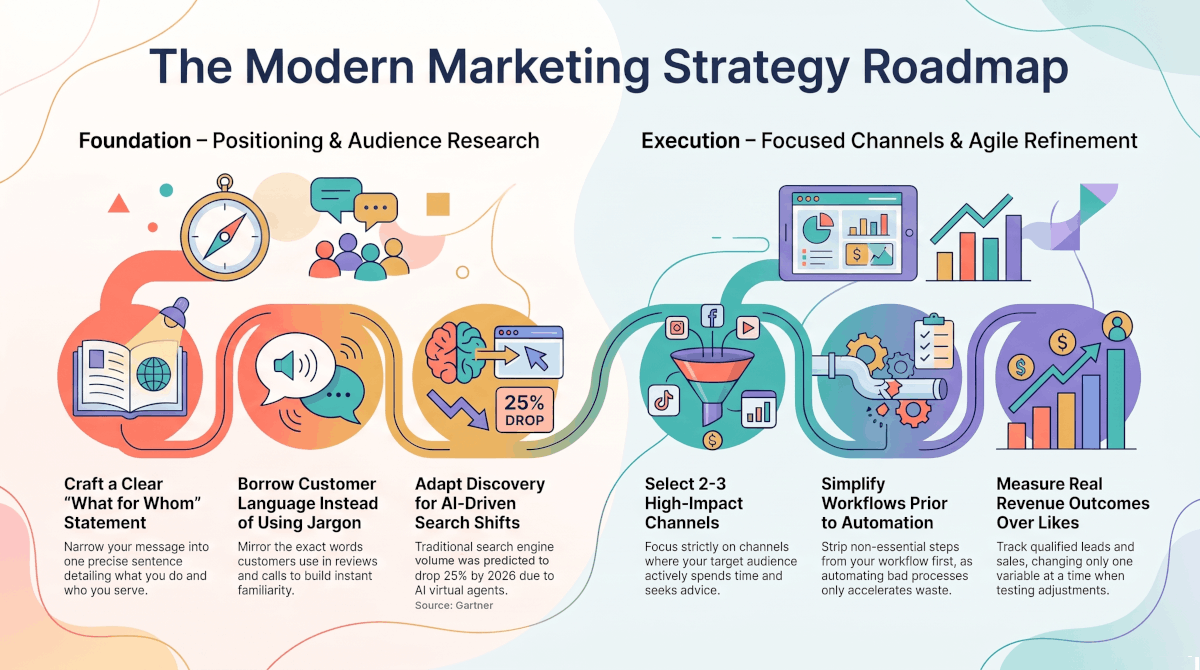
The Modern Marketing Strategy Roadmap: from positioning and audience research to focused channels and measurable results.
What Is a Marketing Strategy
A marketing strategy is the set of decisions that links your business goal to the people you want to reach, the promise you make to them and the reasons they should believe you. In other words, it sets direction. It doesn’t list next Tuesday’s posts.
That’s where a marketing strategy plan comes in. The plan translates direction into action: who does what, when and with what budget. Tactics sit one level lower still, as the individual activities such as an email, a webinar or a short video.
Keeping these layers separate saves you from a common trap. When results dip, many teams swap tactics endlessly while the real problem sits higher up, in an unclear audience or a weak offer. So, before you touch a single channel, work through the steps below in order.
Step 1: Define Your Position with a "What for Whom" Statement
Positioning is the decision that makes everything else easier. If you try to appeal to everyone, your message has to stay vague, and vague messages are exactly what audiences have learned to scroll past.
To sharpen yours, write one sentence using the pattern “[what you do] for [who you serve]”. For example, “bookkeeping for independent cafés” or “strength coaching for runners over 50”. Each version instantly tells the right person “this is for me”, while everyone else knows to move on.
This statement becomes the backbone of your brand strategy development. Your visual identity, tone of voice and offers should all reinforce it. On top of that, your value proposition adds two more pieces: the main benefit you deliver and the proof that makes it believable.
Proof matters more now than it did a few years ago. Because anyone can publish polished claims in seconds, audiences look for evidence instead: real results, specific examples and honest accounts of what went wrong as well as right. In fact, sharing a mistake and what you learned from it often builds more trust than another success story.
Step 2: Research Your Audience and Borrow Their Language

Before you write a single headline, listen. Customer interviews, support emails, sales calls, reviews (yours and your competitors’) and online communities all show you how people describe their problem in their own words.
Those words are marketing gold. For instance, a customer might say they feel “buried in admin”, while a supplier talks about “operational efficiency”. The first phrase lands because it mirrors what the reader already feels, whereas the second sounds like a brochure.
As you gather notes, look for three things:
- The problem people are trying to solve, and what it costs them
- The alternatives they’ve already tried, and why those fell short
- The doubts that stop them from buying
Next, group what you’ve learned into segments with genuinely different needs. Then choose the segment you can serve best and focus there first. A short persona can help your team remember who they’re writing for, as long as you build it from real conversations rather than guesswork.
Finally, review competitors to see how they position themselves. The aim isn’t to copy them. Rather, you’re looking for a gap you can own honestly.
Step 3: Choose the Marketing Strategies That Fit Your Business Model
There’s no official list of marketing strategies, and lists online range from five types to more than fifty. A more useful way to think about them is by the job they do:
- Attract: search, content, social media, PR, and partnerships bring new people in.
- Convert: landing pages, offers, demos and sales conversations help them decide.
- Retain: email, onboarding and customer support keep them coming back.
- Amplify: referrals, reviews and community turn customers into advocates.
Every business needs something in each group, but the emphasis shifts depending on how you sell.
Local and Service Businesses
Trust and proximity drive most decisions here. Therefore, prioritise local search listings, reviews, referrals and visible community involvement.
Online Shops
Shoppers need to discover the product, compare it and feel confident buying. As a result, product content, search, retargeting and repeat-purchase emails usually carry the most weight.
B2B and High-Ticket Offers
Purchases take longer and often involve several decision-makers. Consequently, expert content, case studies and patient follow-up tend to outperform quick-hit promotions.
Creators and Personal Brands
For creators, the audience is the business. That means consistent publishing, a recognisable point of view and an email list you own matter more than any single viral moment.
Step 4: Select Marketing Channels Based on Where Your Audience Already Is
Popularity is a poor reason to choose a channel. Instead, score each option against four questions. Does your audience actually spend time there? Will it support your goal directly? Can your team show up consistently? And can your budget sustain it?
Audience research tools such as SparkToro can show where specific groups read, watch and listen. Even without tools, you can simply ask customers where they go for advice.
Also, remember that discovery now reaches beyond the search results page. In fact, Gartner predicted that traditional search engine volume would drop by 25% by 2026, as people turn to AI chatbots and virtual agents for answers. Those assistants often draw on public sources such as forums, video platforms and reference sites. So if your audience asks questions in public communities, being genuinely helpful there can shape how both people and AI tools describe your category.
Once you’ve shortlisted channels, give each one a role:
- Discovery: introduces you to people who’ve never heard of you.
- Consideration: answers questions and shows proof.
- Conversion and retention: makes it easy to buy, enquire or return.
Start with two or three channels you can run well. After all, a small, focused mix will beat a sprawling one that leaves you posting sporadically and replying slowly.
To compare the cost, speed and conversion rate of each option side by side, see our guide to traffic sources that convert.
Step 5: Build a Content Strategy Around One Clear Message
A content strategy decides what you publish, for whom and why. The strongest ones revolve around a single core message, so every article, video and post reinforces the same promise from a slightly different angle.
Traditional thinking sorts content into neat funnel stages, with awareness pieces at the top and sales pieces at the bottom. However, real buyers rarely move in a straight line. Someone might discover you through a detailed guide and be ready to buy that same afternoon. If your strongest arguments live only on a sales page, that person may leave before finding them.
So make each piece able to stand on its own. In practice, every piece should:
- Name the problem in the reader’s own words
- Show your point of view on how to solve it
- Offer a clear, relevant next step
It also helps to name the “old way” your audience is stuck with, such as an outdated method or a popular myth. When you contrast your approach with it, readers get a reason to change rather than just another option to weigh up.
Lastly, use AI as a thinking partner, not a ghostwriter. Ask it to challenge your assumptions, spot gaps in your argument or suggest angles you’ve missed. Then make the final calls yourself, because judgement and taste are exactly what generic content lacks.
Step 6: Treat Your Social Media Strategy as a Series of Reps
A social media strategy works best when you stop treating each post as a big launch. Launches feel high-stakes, so teams delay and over-polish them. Reps, on the other hand, are small, regular experiments that teach you what your audience responds to.
Think of each post as a test of a message. Did a certain problem statement get replies? Which specific examples got saved or shared? Over a few weeks, these signals tell you which ideas deserve a longer article, a video or a paid campaign.
Equally, substance beats production value. A clear, useful video filmed on a phone will usually outperform a beautifully lit one with nothing new to say. Quality still matters, of course; it simply lives in the idea rather than the lighting.
Finally, watch the early response after you publish. Most platforms show a post to a small group first and widen its reach if people engage. Constant weak posts can therefore train both the algorithm and your followers to ignore you, so choose fewer, stronger posts over filler.
Step 7: Turn Your Strategy into a Marketing Strategy Plan
With your direction set, it’s time to make it practical. A marketing strategy plan should spell out, for the next 90 days, who owns each activity, what they’ll deliver and by when.
When you budget, include more than ad spend. Content production, tools and, above all, the time needed to reply to enquiries and serve new customers all count. Also, reserve some capacity for testing, though not so much that your steady, proven activity slips.
Before automating anything, simplify. Review your workflow and question every step: why does it exist, and what happens if you drop it? Remove the steps that don’t clearly improve results, then streamline what’s left. Only after that should you automate, because automating a wasteful process produces waste faster.
Shorter feedback loops help, too. A quick daily or twice-weekly check-in covering who’s doing what and by when keeps work moving and exposes bottlenecks early. By contrast, weekly updates often let small delays quietly stack up.
Step 8: Measure, Test and Refine Your Marketing Strategies
Match your key metrics to your goal. If you want leads, track qualified enquiries. For product sales, track purchases and repeat purchases. Meanwhile, likes, views, and clicks help with diagnosis, but they aren’t the result you’re after.
When you test, change one meaningful thing at a time, such as the audience, the offer, the headline or the landing page. That way, you’ll know what caused the difference.
Be patient with slower channels, too. Search and content often take months to build momentum, so judge them on early signals like rankings, subscribers and returning visitors before writing them off.
Then, at regular review points, decide whether to continue, adjust, expand or stop each activity. Base that call on its contribution to your goal, the quality of the results and the effort it demands. Keep a short log of what you changed and why, so future reviews build on real learning rather than memory.
Quick Recap
- Define your position with a “what for whom” statement and back it with honest proof.
- Research your audience and reuse the language they actually use.
- Choose marketing strategies that match how your business sells.
- Pick two or three channels based on where your audience already spends time.
- Build content around one core message, with each piece able to stand alone.
- Run social media as a series of small, regular tests.
- Turn your strategy into a 90-day plan, simplifying before you automate.
- Measure real outcomes, test one change at a time and review regularly.
Frequently Asked Questions
What’s the difference between a strategy and a plan in marketing?
A strategy sets direction: who you serve, what you promise and why people should believe you. The plan, in turn, converts that direction into scheduled work, owners and budgets. You need both, but the strategy should come first.
What are the main types of marketing strategies?
There’s no fixed official list. A practical approach is to group them by job: attracting new people (search, content, social, PR), converting them (offers, landing pages, sales), retaining them (email, onboarding) and amplifying word of mouth (referrals, reviews, community).
How many marketing channels should a small business use?
Most small teams do best with two or three channels they can run consistently. Once those work and the routine feels sustainable, add another.
Is brand strategy the same as marketing strategy?
No. Brand strategy development shapes how people recognise and feel about your business. Your marketing strategy then uses that brand to reach, convert and keep customers. The two should align, but one doesn’t replace the other.
Can you grow a business without paid ads?
Yes. Content, search, email, partnerships and referrals can all grow a business without ad spend. The trade-off is time, since organic approaches usually take longer to build reach and trust.
How often should you review your marketing approach?
Check performance monthly and revisit the overall strategy every quarter. However, review it sooner if your offer, audience or market changes significantly.
Over to You
Now it’s your turn. Pick one step from this guide, whether that’s writing your “what for whom” statement or trimming your channel list, and put it into practice this week. Then come back and tell us how it went.
Which of these steps do you find hardest, and what has worked for your business so far? Leave a comment below and share your experience. After all, your answer might be exactly the tip another reader needs.
