
How to Build a Content Strategy in the Age of AI: 7 Steps That Work
AI has made content almost free to produce. As a result, the internet is filling up with average, interchangeable posts that nobody remembers, which many marketers now call “AI slop.” For creators and businesses of any size, that’s actually good news. You can’t out-publish a machine, and you don’t need to. Instead, you need a content strategy built on the things AI can’t fake: a sharp point of view, real experience, and honest stories. This guide walks you through building a content strategy in the age of AI in seven steps, from positioning to publishing.
Key Takeaways
| What you’ll do | Why it matters (in 2026) | What you get |
|---|---|---|
| Pick a sharp position with the “X for Y” formula | Generic voices blend into the flood of AI content. | People and AI tools can remember and recommend you. |
| Go where your audience listens, including AI answers | AI assistants now sit between you and many buyers. | Your expertise shows up where decisions get made. |
| Make every piece stand alone with your core message | Buyers rarely follow a neat funnel. | Any post can turn a reader into a lead. |
| Tell the whole truth, failures included | Audiences are skeptical of polished success stories. | Trust that AI-written content can’t copy. |
| Use AI as a thinking partner, not a ghostwriter | Fully AI-written content sounds like everyone else’s. | Faster work that still sounds like you. |
| Publish often instead of waiting for perfect | Small, regular posts teach you more than rare, polished ones. | A steady rhythm that shows you what works. |
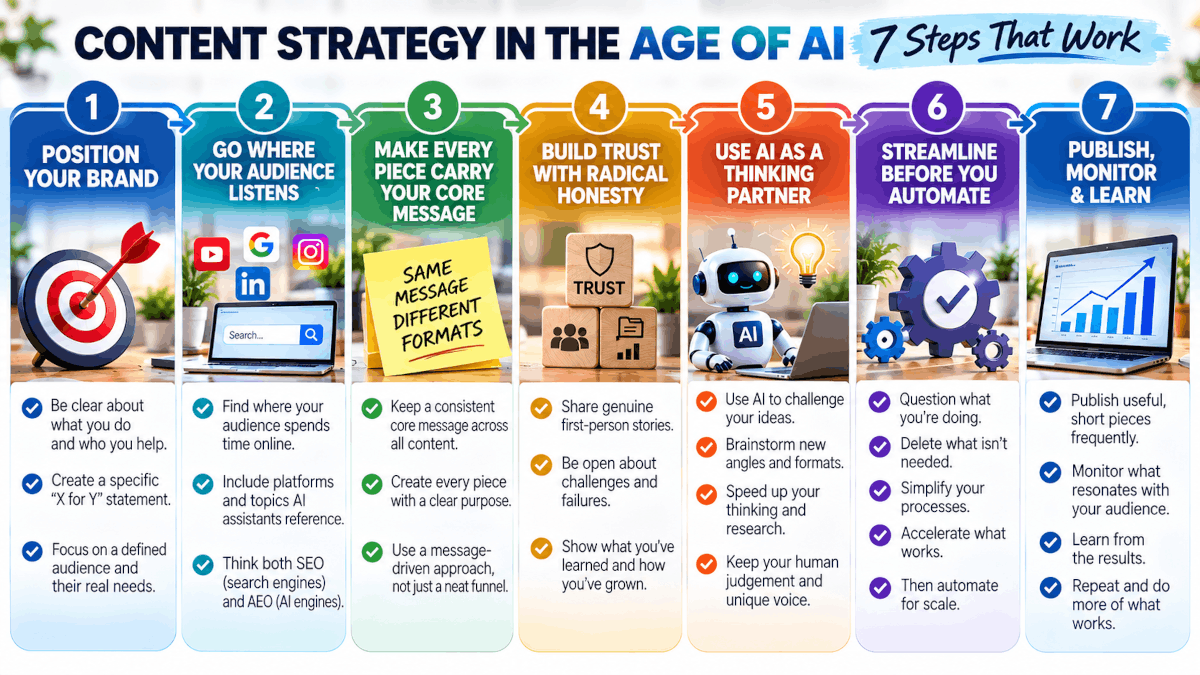
"The 7 steps to a content strategy that stands out in the age of AI, at a glance."
Step 1: Position Your Brand with the "X for Y" Formula
Generic positioning is the fastest way to disappear. If you describe yourself as a “marketing consultant” or a “productivity coach,” you compete with thousands of people who sound the same. So before you plan a single post, narrow your focus until you become the obvious choice for one group.
The simplest tool here is a fill-in-the-blanks formula: [what you do] for [who you serve]. For example:
- Bookkeeping for independent physiotherapy clinics
- Website copywriting for wedding photographers
- Strength training programs for runners over 50
Notice how each line instantly tells the right reader “this is for me.” It also tells everyone else to move on, and that’s the point. Specific positioning makes your content easier to write, too, because you always know who you’re talking to and what they struggle with.
Once you’ve chosen your line, test it. Put it in your bio, your About page, and the first sentence of your next few posts. If people start describing you to others in the same words, your content positioning is working.
Step 2: Go Where Your Audience Listens (and Master Answer Engine Optimization)
Your content only works if it lands in front of the right people. However, the right place is shifting. More buyers now ask AI assistants like ChatGPT, Perplexity, and Gemini for recommendations instead of scrolling through search results. In effect, those tools have become a new layer of gatekeepers between you and your prospects.
Answer engine optimisation (AEO) is the practice of making your expertise easy for these tools to find, understand, and cite. It doesn’t replace SEO; rather, it adds a second audience. Here’s how the two compare:
| Traditional SEO | Answer engine optimization | |
|---|---|---|
| Main audience | People scanning search results | AI assistants writing direct answers |
| Reader’s goal | Find a link to click | Get an answer right away |
| What helps you | Keywords, backlinks, useful pages | Clear answers, topical authority, mentions on trusted sources |
So where do AI assistants look? Several large studies point the same way. For instance, one analysis of 30 million AI citations found Reddit, YouTube, and LinkedIn among the most-cited domains, alongside Wikipedia. Your own website still matters, but so do the conversations happening elsewhere.
To put this into practice, use an audience research tool such as SparkToro to see which sites, podcasts, and communities your ideal customers actually use. Then show up there with genuinely helpful answers. After all, if your prospects gather on Reddit and you only post on LinkedIn, you’re talking to the wrong room.
Not sure which channels deserve your time? Our map of traffic sources that convert compares each one on cost, speed, and how well its visitors turn into leads.
Step 3: Replace the Funnel with Message-Driven Content
The classic marketing funnel assumes people move neatly from awareness to consideration to purchase. In reality, customer journeys are messy. Someone might find your newest post, feel ready to buy on the spot, and then leave because your best arguments are buried in a “bottom-of-funnel” email sequence.
That’s why a message-driven approach works better. Instead of spreading your story across stages, make sure every piece of content carries your core message by itself. Whether someone reads one post or fifty, they should understand what you believe, who you help, and why it matters.
Two techniques make those messages land:
- Mirror their words. Use the exact language your prospects use to describe their problem. If they say they feel “overwhelmed,” don’t write about “resource allocation challenges.” Reviews, comments, and sales calls are goldmines for this phrasing.
- Name the villain. Identify the old way of doing things that’s failing your audience, such as a broken industry standard or a hustle-culture myth. Then show clearly why it doesn’t work.
In short, don’t just pitch a better solution. First, help your reader see the problem more clearly than before, so your offer feels like the natural next step.
Step 4: Build Trust with Radical Honesty

Audiences have grown sceptical of polished success stories. As a result, plain honesty has become one of the most persuasive things you can publish. Telling the whole truth, including the parts where you don’t look great, gives people a reason to believe the rest.
Consider two versions of the same background story. The first says: “I’ve spent a decade helping agencies grow.” By contrast, the second says: “I once ran an agency that failed because I was great at landing clients but terrible at delivery. Now I help strong operators win the clients they deserve.” That second version is more memorable, more believable, and far harder for anyone else to copy.
Many people who say they have imposter syndrome are really holding back part of their story. So look for the lessons you learned the hard way: the launch that flopped, the pricing mistake, the client you shouldn’t have taken. Share what happened, what you changed, and what your reader can take from it.
This kind of first-person storytelling is also your best defence against AI slop. A language model can summarise common advice, but it can’t invent your lived experience.
Step 5: Use AI as a Thinking Partner, Not a Ghostwriter
AI tools like ChatGPT or Claude can save you hours. Still, if you let them lead, you’ll mostly get a polished version of average ideas. A better model comes from chess. After losing to IBM’s Deep Blue in 1997, Garry Kasparov championed “centaur” chess, where a human and a computer play as a team. The human supplies strategy and judgment, while the machine handles calculation.
Apply the same split to your content. You decide the angle, the story, and the opinion. Then use AI to stress-test your thinking with questions like these:
- What am I not seeing here?
- Which of my assumptions would change everything if it turned out to be false?
- What would have to be true for this idea to work?
- What are the second- and third-order consequences of this advice?
There’s also a practical reason to keep your own skills sharp. In 2009, the autopilot on Air France Flight 447 disconnected after its airspeed sensors iced over, and the crew never recovered from the stall that followed. For creators, the stakes are far lower, yet the lesson holds: when the tool fails or gives you nonsense, you still need to know how to fly. AI can calculate, but taste, judgment, and discernment remain your job.
Step 6: Streamline Your Content Workflow Before You Automate It
When time is short, it’s tempting to automate everything. However, automating a wasteful process just helps you waste time faster. Elon Musk’s five-step engineering “algorithm,” described in Walter Isaacson’s biography, offers a better order of operations for your content workflow:
- Question every requirement. For each step in your process, ask: What does it mean? How do I know it matters? So what? If you spend an hour colour-grading videos with no evidence it improves watch time, that hour is suspect.
- Delete. Remove steps that don’t clearly move the needle. According to Musk’s rule of thumb, if you never have to add anything back, you probably didn’t delete enough.
- Simplify and optimise. Look for tasks that eat a large share of your time but add little quality. Two useful pieces at 95% polish usually beat one at 100%.
- Accelerate. Shorten the gap between finishing work and publishing it. A post that takes two hours to write shouldn’t sit in drafts for a week.
- Automate. Only now should you bring in AI and other tools, applied to a process that’s already lean.
The biggest win usually comes from the second step. Choosing not to do something is always more efficient than automating a task that never needed to exist.
Step 7: Publish Short, To-the-Point Pieces Often and Monitor the Response
Many beginners spend weeks polishing a single post or video before they share it. Then, when it gets little attention, they feel crushed. A better approach is to treat every piece of content as a small test. Each one shows you what your audience likes, and you get a little better with every post.
Focus on what you say, not on how fancy it looks. For example, a clear, useful video recorded on your phone will usually do better than a beautifully lit one that says nothing new. So don’t worry about lighting, editing, or perfect thumbnails until your message is working.
At the same time, don’t post just for the sake of posting. Many platforms decide how widely to show a new post partly by how people react to it soon after it goes live. If you share lots of weak content, fewer people engage, and the platform starts showing your posts to fewer people. Instead, aim for genuinely useful pieces, shared on a schedule you can keep up.
Over time, you’ll build a body of work that people recognise you for. Keep track of which posts get the best response, make more of those, and drop what doesn’t work.
Quick Recap: Your AI-Era Content Strategy in 7 Steps
- Position yourself with a specific “what you do for whom” statement.
- Find where your audience spends time, including the sources AI assistants cite.
- Make every piece carry your core message instead of relying on a funnel.
- Share honest, first-person stories, including your failures.
- Use AI to challenge and speed up your thinking, not to replace it.
- Question, delete, and simplify your workflow before you automate it.
- Publish small, frequent reps and learn from what resonates.
Frequently Asked Questions
What makes a good content strategy in the age of AI?
A good content strategy is a clear plan for what you publish, who it’s for, where it appears, and what you want it to achieve. In the age of AI, it also has to stand out from mass-produced content. So it relies on sharp positioning, real expertise, and a sustainable rhythm rather than sheer volume.
Do you still need a content strategy when AI can write for you?
Yes, arguably more than ever. When anyone can generate endless posts, content without a plan simply blends in. Even a one-page plan covering your positioning, platforms, and core message makes every piece work harder.
How often should you publish as part of your content strategy?
Publish as often as you can while keeping quality high and the schedule sustainable. For most creators and small teams, one or two strong pieces a week beat daily filler. Consistency matters more than frequency, so pick a rhythm you can keep up during busy weeks.
Can I use AI to write my content?
You can use AI to brainstorm, outline, edit, and challenge your ideas. However, content written entirely by AI tends to sound generic, which is exactly what readers have learned to ignore. Keep the opinions, stories, and final judgment your own.
What is answer engine optimization (AEO)?
Answer engine optimization means making your content easy for AI assistants like ChatGPT and Perplexity to find, understand, and cite. In practice, that involves answering questions clearly, building authority on your topic, and appearing on sources these tools often cite, such as Reddit and YouTube.
How do I stand out when AI-generated content is everywhere?
Lean on what AI can’t copy: your specific niche, your real experience, and honest stories about what worked and what didn’t. A clear point of view is also hard to fake. When your content sounds unmistakably like you, it stops competing with generic output.
Which platform should you focus on first?
Start with the platform where your ideal customers already spend time, not the one that’s trendiest. An audience research tool can show you where they gather. Then focus on one or two channels until your process runs smoothly. If your website is brand new, our guide on how to get traffic to a new website shows how to pair one fast channel with one slow one.
