
Online Business Problems People Find When Building Their Online Business.
Building an online business is now easier than it has ever been. Anyone can register a domain, open a store, or publish a website in an afternoon. But that’s just the first step; running and growing your business afterward is where the real work begins.
Maybe you’re just getting your online business off the ground. Or maybe you’ve been building it for a while now.
In this article, we cover the most common online business problems people find most challenging. We cover the biggest complaints people report when building their own online business, along with a way to fix each one. What matters is knowing which problem you’re in and what actually fixes it.
Key Takeaways
- Most online business problems come back to one thing. It’s easy to build a website. It takes much longer to build a steady way of finding customers and earning their trust.
- Your online business problems change as your business grows. At first, you struggle to get people to visit your site. Once people are visiting, you struggle to get them to buy. And once they’re buying, you struggle to keep enough money in the bank and not burn yourself out.
- Trust is usually the real problem, more than traffic. This is especially true when you don’t have a physical shop and no one has heard of you yet.
- You don’t need to fix everything at once. Just work on the problem that matches where your business is right now.
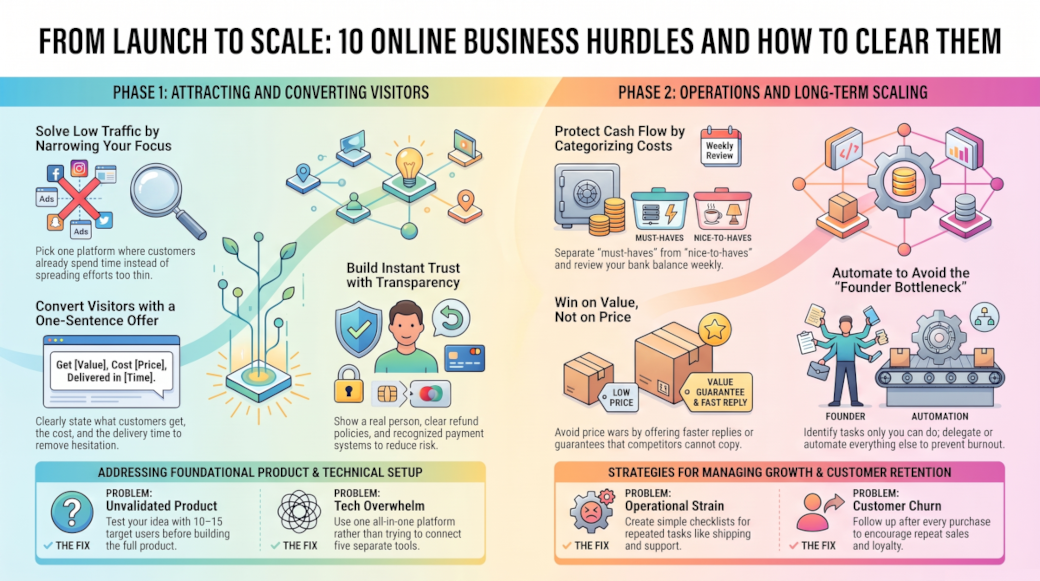
"Ten problems covered in this article, from getting your first visitors to keeping customers coming back and the fix for each one."
1. Getting Traffic and Customers
This is the most common complaint of all. You build the website, you put up your product, and then you wait. But the visitors never show up. Maybe search engines like Google aren’t showing your site to anyone yet. Or maybe you’re competing with big, well-known companies for the same customers. Which could mean you made the biggest mistake of all by not validating your business idea in the first place. Maybe you’re posting on too many different media channels at once, instead of doing a great job on just one.
Your feeling highly frustrated because the “hard part,” building your business/product, after putting in hours of work, it already felt finished. Yet without visibility, none of it matters.
The Fix
Pick one place where your customers already spend their time, and focus on that before you try anything else. Think about how people would actually go looking for a business like yours. Would they type a question into Google? If so, build a few strong pages on your website that answer that question really well.
Don’t spread that effort across a messy blog with lots of random topics. Do your customers hang out on one app instead, like Instagram or TikTok? If so, show up there regularly, instead of posting a little bit everywhere. Doing a great job in one place beats doing an average job in five places. It also shows you what’s actually working before you try to do more.
2. Getting Traffic But Not Converting Them to Sales
Getting visitors solves one problem, but it can create a new one. People show up, maybe they even follow you or sign up for your emails, but nobody buys anything. Usually this happens for one of two reasons. Either it isn’t clear what you’re actually offering, or you’re asking someone to do too much too soon. Sometimes there’s just nothing on the page that makes a stranger trust you enough to pay.
Someone who leaves without buying isn’t saying your product is bad. More often, you just haven’t given them a clear enough reason to buy right now.
What Helps
Write your offer in one simple sentence: what the customer gets, how much it costs, and how soon they get it. Then clean up your page. Keep only that one offer, one clear button telling people what to do next, and one piece of proof, like a review or a real result someone got. Everything extra on the page is one more chance for someone to click away instead of buying. Remove anything that doesn’t directly help someone decide to buy.
If you’re running ads and they’re not converting, don’t start from a blank page. Go look at ads other people are already running for similar products, and pay attention to which ones seem to be working. A lot of ad platforms let you see this directly, and you can also just watch which competitor ads keep showing up again and again, since that usually means they’re getting results.
You don’t need to copy them word for word. Study what they’re doing well, then make your own version of it. There’s no prize for reinventing something that already works.
3. Building Trust on a New Website
When you don’t have a physical shop, you’re asking someone to hand over money to a business they’ve never heard of. New websites usually don’t have many reviews, aren’t well known, and don’t have a track record yet. People know that scams exist online, so it’s completely normal for them to hesitate. It’s not personal.
The Trust Fix
Show that there’s a real person behind the business: your name, a photo, and a way for people to reach you. Use specific proof instead of vague compliments. Saying “saved customers 6 hours a week” works much better than saying “great service.” Make your prices, shipping times, and refund policy easy to find. Use a payment system people already recognise and trust. None of these things alone will make someone buy. Together, though, they make your business feel safer to a nervous first-time visitor.
A large research firm called BCG found that lowering how risky a purchase feels matters more than just making the website look pretty.
4. Choosing the Right Product for the Right Crowd
A lot of people start a business around something they personally enjoy. They never check whether anyone else actually wants to buy it. Others pick something too broad, like “fitness” or “marketing,” and can’t stand out from everyone else doing the same thing. Some people go too narrow and end up with barely any customers at all. A common mistake is describing your product instead of your customer. “I sell planners” tells people what you make, but not who needs it or why. If any of this sounds familiar, it usually means you didn’t validate your business idea before you started building.
Test It First
Write down your idea as one sentence: “I help [a specific group of people] solve [a real problem they have] so they can get [a clear result].” Then test that idea before you build anything else.
Talk to 10 to 15 people in that group. Ask how they currently deal with the problem. Try offering something small, like a simple landing page or a way to pre-order, and see if people actually show interest. You’re not trying to find zero competition. Instead, look for a real group of people with a real problem, who have a reason to choose you.
5. Overwhelming Tech Problems
Building a website, setting up payments, sending emails, checking your stats, automating tasks, and keeping everything secure can pile up fast. This is especially true if you’ve never done anything technical before. It’s easy to lose a whole day on one small setup step. That same step might take a more experienced person just an hour.
Simplify, Don’t Master
You don’t need to become an expert at every single tool. Just solve whatever is stopping you right now. Pick one all-in-one platform that handles your website, payments, and emails together. Don’t try to connect five separate tools yourself. Only add more tools once you actually need them. If you get stuck, paying someone for a short session is often cheaper than losing a whole weekend to trial and error, in both time and stress.
6. Cash Flow Problems

Ads, software subscriptions, stock, freelancers, and other costs all use up your cash before your business is making steady money. Most people underestimate how long it actually takes to become profitable. A slow patch can feel like a disaster, even when the business is still doing fine underneath.
Steady the Cash Flow
Before you spend any money, sort your costs into two groups: “needed to launch” and “nice to have.” Wait on the second group until your sales can pay for it. Keep a simple running total of money coming in versus money going out. Check it every week, instead of only looking when things already feel bad. If a cost doesn’t clearly bring in a sale or protect one, it can usually wait a few more months. The SBA’s guide to managing finances is a free, simple place to start if you want more structure.
7. To Much Competition and Pressure to Reduce Prices
Online, customers can compare your prices to every competitor’s within seconds. Other businesses can copy your product, your posts, and your offer almost as fast as you put them out. That pressure pushes a lot of people into a price war they can’t actually afford to win. Shopify lists pricing pressure as one of the biggest challenges online stores face, right alongside standing out and keeping customers coming back.
Win on Value, Not Price
Compete on something a rival can’t copy overnight, like faster replies, a stronger guarantee, or a very specific speciality. Or simply offer a much better overall experience for the customer. If you only compete on price, the business with the lowest costs usually wins by default. That’s rarely a small, new business like yours. Add more value instead of dropping your price.
8. Trying To Do It All On Your Own
Most solo business owners end up handling the product, the content, the marketing, the sales, customer support, the bookkeeping, and the shipping, all at once. The result is usually inconsistent posting and slow replies to customers. Making constant decisions all day also leads straight to burnout.
Stop Being the Bottleneck
Write down every task your business needs done each week. Mark each one as either “only I can do this” or “someone or something else could do this instead.” Hand off or automate everything in that second group first. Use a scheduling tool for your posts, a template for messages you send often, or a few hours of a freelancer’s time for the tasks that drain you the most. You don’t need a whole team on day one. Just stop being the one thing everything else is waiting on.
9. Managing Operations as Your Business Grows
More orders sound like great news, until they expose problems that were hiding when business was slow. You might suddenly run out of stock or face shipping delays. Returns and support messages can pile up faster than you can answer them. Growth doesn’t create these problems so much as it reveals that your systems weren’t ready.
Get Ahead of the Strain
Write down one simple set of steps for each task you do often, before more orders force your hand. Spell out exactly how an order gets shipped, how a return gets handled, and how a support message gets answered. A basic checklist beats having no plan at all, and it means you can hand a task to someone else without everything falling apart.
10. Keeping Customers And Adapting To Change
Getting that first sale is genuinely hard, but a lot of people treat it like the finish line instead of the starting line. Meanwhile, competitors, apps, and what customers want keep changing. A business that doesn’t keep adapting slowly loses the ground it worked so hard to gain.
Bring Them Back
Follow up after every single purchase. Ask how it went, and make it easy for someone to buy again. Give your existing customers a reason to come back before you spend more money chasing brand-new ones. Keeping a customer is almost always cheaper than finding a new one. A short “how did it go?” email or a simple reward for returning customers often does more for your income than another round of ads.
Quick Recap
1. Nobody finding you: focus on one place your customers already are, instead of spreading yourself thin.
2. Traffic not turning into sales: make your offer clear, remove distractions, and study ads that already work before running your own.
3. Strangers don’t trust you: show a real person, real proof, and clear policies.
4. Not sure what to sell: write and test a one-sentence idea of who you help and how.
5. Tech feels overwhelming: solve today’s problem with one simple platform, not five separate tools.
6. Cash running low: separate must-have costs from nice-to-have costs and check your numbers weekly.
7. Competitors undercutting you: compete on value they can’t copy, not on price.
8. Doing everything alone: hand off or automate anything that doesn’t need to be you.
9. Growth causing problems: write a simple plan for each repeated task before you grow more.
10. No repeat customers: follow up after every sale and make it easy to buy again.
Frequently Asked Questions
Why is my online business not getting any traffic?
Most new websites struggle to get noticed because they try to be everywhere at once. Pick the one place your customers already spend time, and be consistent there first.
Why do people visit my website but not buy anything?
Usually your offer isn’t clear enough, or you’re asking a stranger to do too much too soon. Simplify your offer to one sentence, and remove anything that doesn’t help someone decide to buy.
How do I build trust for a new online business with no reviews yet?
Show a real person behind the business, use specific results instead of vague compliments, and make your prices and refund policy easy to find. Trust comes from proof, not just a nice-looking logo.
How do I know if my business idea is any good?
Test it before you build anything else. Talk to 10 to 15 people in your target audience and find out how they currently deal with the problem. Look for real signs they’d pay, not just polite compliments.
How much money do I need to build an online business?
It depends on the type of business. The better question is which costs you actually need to launch, versus which ones can wait until you’re making sales.
How do I stop feeling overwhelmed running an online business alone?
Write down everything you do each week, then separate the tasks only you can do from the ones someone or something else could handle. Hand off or automate that second group first.
How do I get customers to buy from my online business again?
Follow up after every purchase, make it simple to reorder, and give existing customers a reason to come back. Keeping a customer is almost always cheaper than finding a brand-new one.
