
Where to Host Your Website and Why Ownership Matters More Than Price.
Every website needs a home on the internet. People call that home “hosting.” So when you pick a hosting company, you are really picking where your website lives. This article is following on from my previous post Hosting Your Website.
Here’s the tricky part. Some hosting companies that look totally different are actually owned by the same parent company. So when you compare two “different” options, you might actually be comparing the same thing twice. This guide breaks down what that means, so you can figure out where to host your website without accidentally paying two “different” companies for the exact same server.
Key Takeaways
- One parent company owns some hosting brands you think are separate, like Bluehost and HostGator.
- People call that parent company Newfold Digital. It used to go by the name EIG, and it owns more than 60 hosting brands.
- A big company owner is not automatically bad news. But it can mean slower upgrades and crowded servers.
- Cheap starting prices often jump a lot when it’s time to renew, so always check the renewal price first.
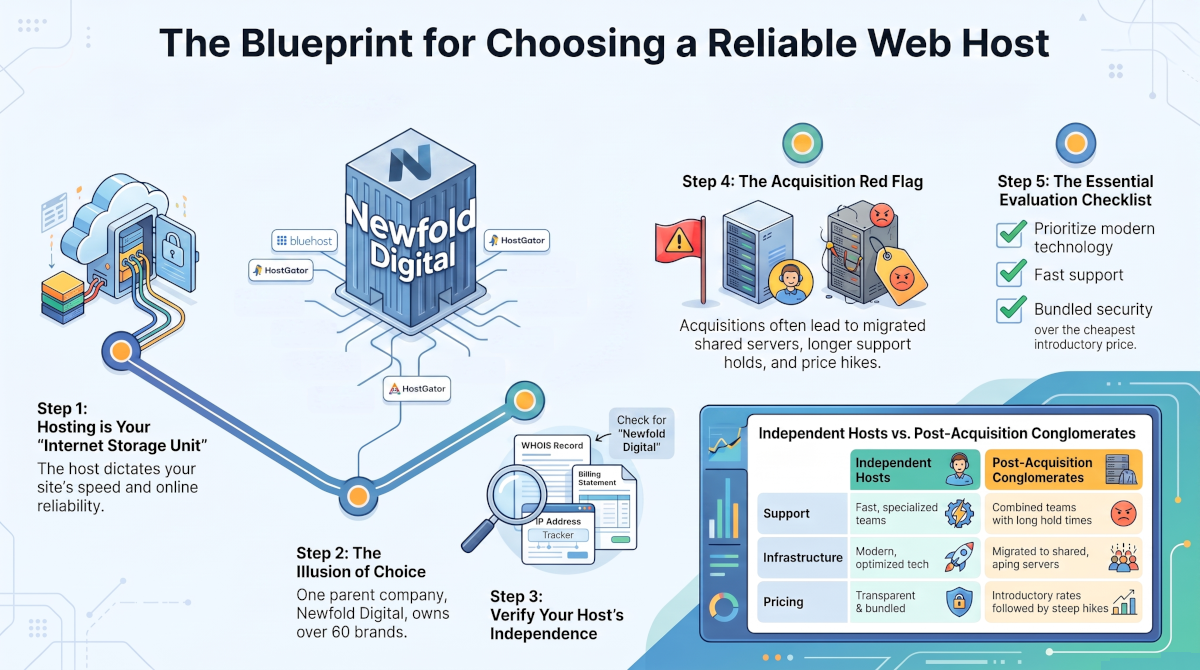
"Where to host your website comes down to more than price this blueprint walks through the 5 steps for spotting who actually owns your host, before you sign up."
5 Steps to Where to Host Your Website
Step 1. What is Web Hosting Really?
Think of hosting like renting a storage unit. Your website’s files, pictures, and pages all need somewhere to sit so people can visit them. A hosting company gives your website that storage space and keeps it running.
When you type a web address into your browser, your computer asks a host’s server to send back the website. So the quality of that host affects how fast your site loads and how often it stays online. A slow or unreliable host means a slow or unreliable website, no matter how good your content is.
Step 2. One Company Many Brand Names
Here’s something a lot of people don’t know. Many popular hosting brands are not separate companies at all. One giant company owns them.
That giant company is Newfold Digital. It used to go by the name EIG (Endurance International Group) before it merged with Web.com in 2021. Today, Newfold Digital owns more than 60 hosting brands, including Bluehost, HostGator, iPage, HostMonster, and Domain.com.
So imagine you leave Bluehost because your site feels slow. You sign up with HostGator instead, thinking you switched companies. In reality, you might have moved to a server run by the exact same parent company. That’s why it pays to know who actually owns your provider before you decide where to host your website next.
Step 3. How to Find Out Who Owns Your Host
Luckily, checking ownership is not hard. Here are four quick ways to do it:
- Search the company’s name alongside “Newfold Digital” and see what comes up.
- Look up your server’s IP address and see which data centre it points to.
- Check the WHOIS record for the company’s domain name.
- Look at your billing statement. Some brands list the parent company’s name instead of the brand name.
Any one of these checks can reveal whether your “independent” host is really part of a bigger group. So it’s worth a two minute search before you commit to a plan.
Step 4. What Happens When a Big Company Buys a Small Company?
When a big company buys a smaller hosting brand, a pattern tends to follow. First, the brand keeps its name and logo, so customers notice nothing. Then, accounts slowly get moved onto the parent company’s shared servers.
After that, support teams often get combined across multiple brands, which can mean longer wait times. Finally, prices tend to rise, and extra features that used to be free get sold as paid add-ons.
That said, big companies do sometimes reinvest in better technology. For example, Bluehost is currently moving its infrastructure to Oracle Cloud, a major upgrade aimed at improving speed and reliability. So ownership by a large company is not always bad news. It just means you should watch closely for changes after any acquisition.
Step 5. How to Pick the Right Host For You
Deciding where to host your website comes down to more than the cheapest price. Instead of just chasing a low number, look at what you are actually getting. A few smart questions to ask:
Does the price jump a lot after the first year?
Is the technology modern, or outdated?
Does customer support feel fast and knowledgeable, or slow and scripted?
Are backups and security included, or sold separately?
Is the company independent, or part of a larger portfolio?
Answering these questions matters more than chasing the lowest sticker price. Because a cheap plan that slows down or gets bought out can cost you more time and money later.
Quick Recap
Here’s the short version of where to host your website, without the technical detour:
1. Hosting is where your website’s files live online.
2. Many popular hosting brands share one parent company, Newfold Digital.
3. You can check who owns your host through a quick search, IP lookup, WHOIS record, or billing statement.
4. Big company ownership can mean slower support and rising prices, but it can also fund real upgrades, like Bluehost’s move to Oracle Cloud.
5. Choose a host by comparing renewal prices, technology, support, and included features, not just the intro price.
Frequently Asked Questions
Is Bluehost the same company as HostGator?
Newfold Digital owns both brands, but they run as separate labels. So they often share infrastructure behind the scenes.
Why do hosting companies buy other hosting companies?
Buying smaller brands lets a big company reach more customers. It also cuts costs by combining servers and support teams.
How can I find out who really owns my provider?
Search the brand name alongside “Newfold Digital,” check the WHOIS record, or look at your billing statement for the parent company’s name.
Will my website slow down after an acquisition?
Not always right away. But shared, crowded servers after a buyout can sometimes slow things down over time.
Is Bluehost’s cloud upgrade a big deal?
Yes. Moving to Oracle Cloud is a significant infrastructure change that could improve speed and reliability, which is worth watching if you already use Bluehost.
Can I switch providers without losing my website?
Yes, most hosting companies offer migration help. They move your files and data to a new provider with minimal downtime.
There are also WordPress plug-ins you can use, which make it simple to move your website from one host to another.
Bottom Line
At the end of the day, where to host your website matters less than who actually owns and runs it behind the brand name. Check ownership, check the renewal price, and check the tech then pick with your eyes open.
