Traffic Sources That Convert (and Where to Start)
You’ve built the website, written the content, and set up a real offer. Yet your analytics still show almost nobody visiting. That’s one of the most demoralising moments in any online business, because no traffic means no sales.
When that happens, most people chase every traffic source at once. They post on every platform, dabble in ads, and half-write a few SEO articles. Unsurprisingly, none of it works. In practice, doing one traffic source well beats doing all of them badly.
This page is your map. It gives a short, honest overview of each major traffic source, including what it costs, how fast it works, and how well it converts. After that, you can decide where to focus first.
Key Takeaways
- Not all traffic is equal. Visitors who arrive with a problem to solve convert far better than people scrolling for entertainment.
- Free traffic sources cost time instead of money, so pick one or two you can keep up every week.
- Most channels are borrowed. Google and social platforms decide who sees you, while an email list is the one audience you own.
- Rising direct traffic is the clearest sign that the rest of your strategy is working.
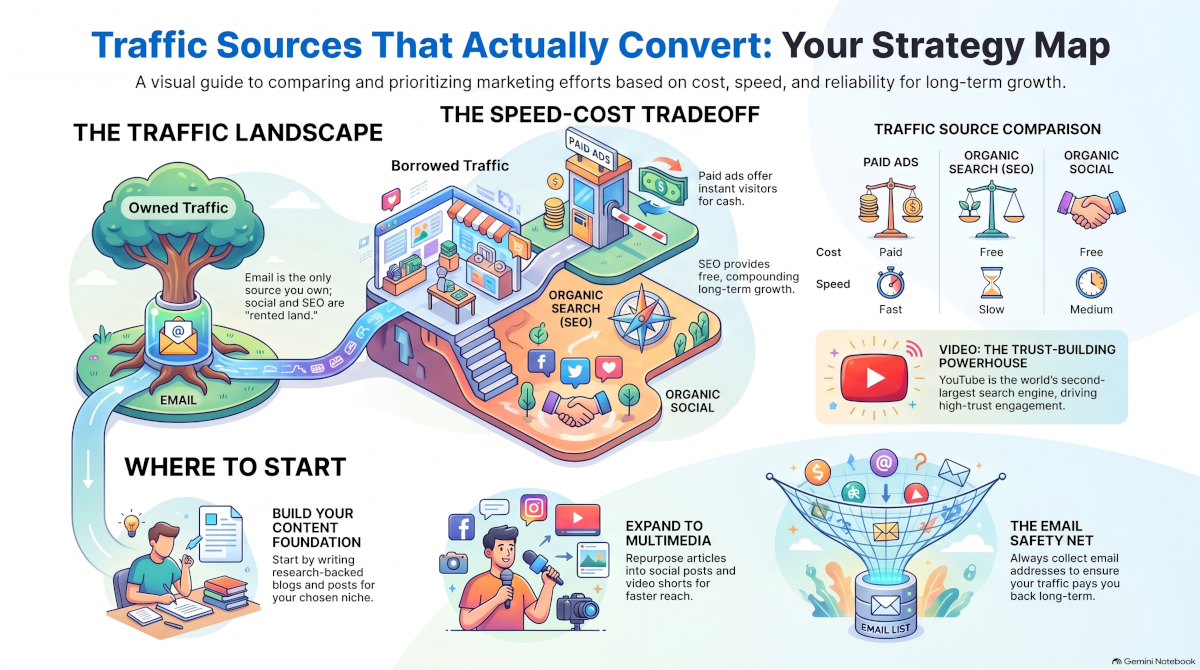
"Traffic Sources That Convert: Your Strategy Map comparing cost, speed, and reliability across major traffic sources."
How to Judge Traffic Sources That Convert
Before you compare channels, it helps to know what “converts” really means. A visitor converts when they take the next step, such as joining your email list or buying your offer. That usually depends on intent. Someone searching “best budget microphone for podcasts” is ready to act. By contrast, someone scrolling a social feed is mostly looking to be entertained.
For that reason, each traffic source below gets three quick ratings: cost, speed, and how well it tends to convert.
1. Organic Search (SEO)
Organic search is traffic that finds you through Google and other search engines, without you paying for the click. In practice, this mostly means blogging. You write articles and guides around the exact questions your audience types into Google. That gives the search engine a reason to show your page.
SEO is the slowest traffic source to build. Often, it takes months before you see meaningful results. However, once a page ranks, it can send visitors for years with very little extra effort. Better still, searchers arrive looking for an answer, so they tend to convert well.
Cost: Free, but time-intensive · Speed: Slow · Converts: High
2. Organic Social Media
Organic social media is the free reach you build by posting on platforms like Instagram, TikTok, X, or Facebook. In the early days, it can grow an audience faster than SEO.
The catch is that you’re building on rented land. A single algorithm change can quietly cut your reach overnight. On top of that, you don’t own the relationship the way you do with an email list. Social followers also tend to convert more slowly, because most of them found you by chance rather than by searching.
Cost: Free, but time-intensive · Speed: Medium · Converts: Low to medium
3. Video Marketing
Video gets its own category here, because the platforms, skills, and strategy are genuinely different from social media. YouTube is widely described as the world’s second-largest search engine. As a result, it behaves more like Google than like a social feed. Short-form video, such as Reels, TikTok, and Shorts, then has its own separate playbook.
Done well, video is one of the most powerful ways to build trust. After all, viewers see and hear you directly instead of just reading your words. It’s also the fastest free route to new visitors, as long as you post consistently.
Go in with realistic expectations on cost, though. Decent equipment and editing are a genuine investment, whether you pay with your own learning time or pay an editor.
Cost: Some investment (equipment and editing) · Speed: Medium to fast · Converts: Medium to high
4. Email Marketing: The Audience You Own
Every other channel on this page is borrowed, because a platform or search engine decides whether people see you. An email list works differently. Once someone subscribes, you can reach them directly whenever you have something worth sharing.
Email is rarely anyone’s first traffic source. Even so, it’s usually the one that ages best. Subscribers already know and trust you, so they convert better than almost any other visitor.
Cost: Free to start, then a paid tool as your list grows · Speed: Medium, but highly reliable · Converts: Very high
5. Referral Traffic and Backlinks
Referral traffic arrives when another website links to yours. For example, it might be a mention in someone’s article, a spot on a resource list, or a partnership. Beyond those direct visitors, backlinks are one of the strongest signals search engines use to judge how far to trust your site. In other words, this source quietly supports your SEO too.
Cost: Free to low-cost, usually earned rather than bought · Speed: Slow · Converts: Medium to high
6. Communities and Forums
This is traffic from places like Reddit, Quora, niche forums, and community platforms such as Skool. Most of them are free to join, although some Skool communities are paid. Either way, they take time.
Communities are often the most overlooked traffic source. Yet they can be one of the most effective. The people there already care about your exact topic, so the traffic tends to convert unusually well. The rule is simple: show up to help, not just to sell.
Cost: Mostly free · Speed: Medium · Converts: High
7. Direct Traffic
Direct traffic comes from people who type your URL into their browser or use a saved bookmark. Strictly speaking, it isn’t a strategy you carry out. Instead, it’s a signal. It grows naturally as your brand becomes more recognisable through everything else you do. So if this number keeps rising, the rest of your traffic strategy is working.
Cost: None (a by-product, not a channel) · Speed: Slow to build · Converts: Very high
8. Paid Ads: The Fastest Traffic Source
Paid ads cover search ads, social ads, and display ads. In short, it’s traffic you buy. The big advantage is speed, since visitors can arrive within hours of launching a campaign. You also get far more control over exactly who sees your offer. The trade-off, of course, is that every click costs money.
Paid traffic only pays off when you plan for the long run. Most visitors won’t buy on their first visit. That’s why the most important step is to collect their email address, because those subscribers can keep paying you back for years.
Cost: Paid from day one · Speed: Fast · Converts: Depends on targeting and your landing page
Where to Start: A Simple Order That Works
You don’t need all eight traffic sources. Instead, build them in a natural order, where each step feeds the next:
- Research your niche, then write a handful of solid blog posts.
- Turn each article into several social media posts.
- Cut the same ideas into short videos, and later add a five to eight minute YouTube video.
- Add an email sign-up to every page, so visitors from all three channels can join your list.
Of the free options, video will usually get you visitors fastest. Only paid ads are quicker. Whatever you choose, consistency matters more than volume. So try to create something every day, even if it’s small, because it all adds up.
For a step-by-step plan built around a brand-new site, read our guide on how to get traffic to a new website. It turns this map into seven practical strategies you can start this week.
Traffic Sources That Convert Quick Recap
- Judge each traffic source on cost, speed, and how ready its visitors are to act.
- Start with SEO content, because everything else can be built from it.
- Repurpose that content into social posts and short videos for faster reach.
- Join one or two communities where your audience already asks questions.
- Capture emails from day one, whichever channel sends the visitor.
- Add paid ads only once your pages turn visitors into subscribers.
- Watch direct traffic as your long-term measure of progress.
Frequently Asked Questions
What are the main types of website traffic sources?
The main types are organic search, organic social media, video, email, referral, community, direct, and paid traffic. Most analytics tools group visitors into similar categories, so you can see which ones are working for you.
Which traffic source converts best?
Email usually converts best, because subscribers already know and trust you. After that, search and community traffic tend to perform well. In both cases, visitors arrive looking for an answer rather than stumbling across you.
What is the fastest way to get traffic to a website?
Paid ads are the fastest, since visitors can arrive within hours. Among free options, short-form video and active community participation usually bring visitors sooner than SEO.
Is free traffic better than paid traffic?
Neither is better in every case. Free traffic costs time and builds slowly, but it compounds. Paid traffic is fast and controllable, but it stops the moment you stop paying. For most new businesses, it makes sense to start free and add paid ads once you have an offer that converts.
How many traffic sources should a new website focus on?
Start with one or two. For example, pair SEO with either short-form video or one active community. Once those run smoothly, add another channel.
Why is direct traffic important?
Direct traffic shows that people remember your brand. When it grows, you depend less on any single algorithm, which makes your whole business more stable.
Your Next Step: Pick Your First Two Channels Today
You don’t need a perfect plan to get started. Instead, choose one slow, compounding channel and one faster one. For example, pair SEO with short-form video, or pair SEO with one active community. Then add an email sign-up to your site before the first visitors arrive.
So block out time in your calendar this week and publish your first piece. After that, give both channels a steady 30 days before you judge the results. Every visitor you earn now makes the next one easier to get.
