
3 Ways To Monetise Your One-Person-Business
This is 2nd part of the article How to Build a One-Person Business. You really need to read Part 1 before continuing with Part 2 to get the maximum benefits.
Building an audience is only half the job. Once people are watching, reading, or following along, the real question becomes how to monetise a one-person business without losing the trust you spent months building.
This article covers three proven paths: helping people one-on-one, selling an info product, and building your own product. Each one demands something different from you, so pick the path that matches where your audience already is. Then avoid the one mistake that quietly kills most launches.
Key Takeaways
- Coaching and consulting are usually the fastest way to your first dollar, even with a small audience.
- Info products work well once you already have people who trust you, since you are selling a shortcut, not just information.
- Building a product is the slowest path, but it can create the most durable, scalable income over time.
- The biggest launch killer is building your offer before you build your audience, so sequence matters as much as the offer itself.
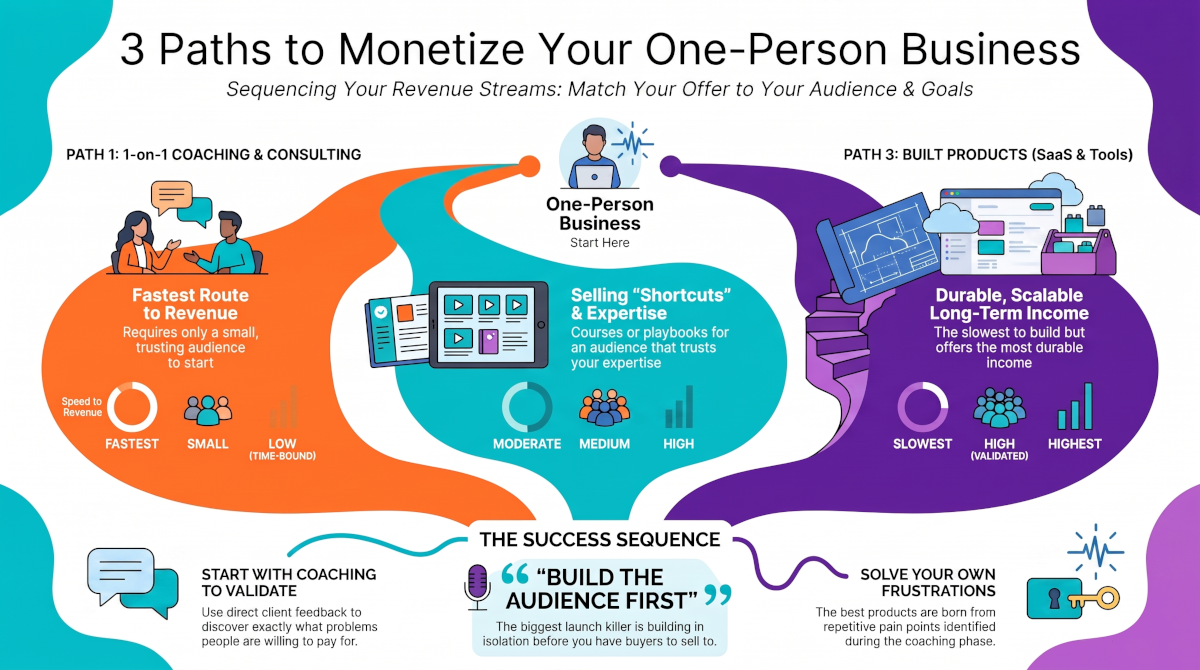
"Three paths to your first dollar and the one step that comes before all of them."
Option 1: Offer 1-on-1 Coaching The Fastest Way To Monetise Your One-Person Business
Helping people directly, through coaching, consulting, or done-for-you work, is often the quickest route to your first dollar. It works even with a small following. You only need a handful of people who trust you enough to pay.
This path fits naturally once you start building a personal brand. Every video, post, or article builds a little more authority in your niche. As a result, people already watching you are primed to ask for help. You do not need a funnel or a sales page to start. A comment reply or a direct message is often enough.
Why Coaching Gets You Paid First
Coaching skips the two slowest parts of monetisation: building a product and convincing strangers to trust it. Instead, you are selling access to yourself, and the people asking are usually already following your work. That familiarity shortens the entire sales process from weeks to a single conversation.
How to Land Your First Coaching Client
Watch your comments and messages for people asking specific, detailed questions. Someone asking “How do I actually get started?” is a browser. But someone asking “Can you look at my first three posts and tell me what’s wrong?” is a buyer. Reply to that second kind of question with an offer, such as a short paid call booked through a scheduling tool like Calendly, a review, or a set number of sessions.
Keep your first offer simple. A single call or a short review package is easier to sell and deliver than an open-ended coaching program. It also gives you real feedback on what people actually want before you build anything bigger.
Option 2: Sell an Info Product to Monetise What You Know
An info product packages your knowledge into something people can buy without needing you directly. A course, a community, a playbook, and a template all count. People are not just paying for information; they are paying for a shortcut. That shortcut saves them the weeks of trial and error you already went through.
This path only works once you have an audience. An info product needs buyers who already trust that you know what you are talking about. Selling to strangers with a cold audience is a much harder, more expensive game.
What Makes an Info Product Worth Buying
The products worth making, and worth buying, share three traits. First, they are priced reasonably for what they deliver. Second, they set correct expectations about the outcome. Third, they clearly explain the exact shortcut a buyer is getting. A course that condenses 60 days of trial and error into a weekend is a fair trade. By contrast, a vague promise with no clear outcome is not.
Where to Host and Sell It
You do not need custom software to sell an info product. Platforms like Gumroad handle payments, hosting, and delivery for you. That frees you up to focus on the content itself, not the plumbing behind it. Keep your first version small. One clear outcome, delivered well, beats a bloated curriculum nobody finishes.
Option 3: Build a Product to Monetise for the Long Term
Building your own product, an app, a tool, or a piece of software, is the third path. It usually starts from your own frustration: some repetitive problem you kept running into that nothing else solved well.
This path can create the most durable income of the three. A product keeps working for you even when you are not actively selling it. That durability comes at a cost, though, so it is worth understanding before you commit months of your time.
Why This Path Takes the Longest
Unlike coaching or an info product, a product needs to be built before it can be sold. Building takes time, even with AI tools speeding up development. If you are not technical, you will also need to learn enough to direct the build, or find someone to build it with you. Neither of those happens overnight.
When Building a Product to Monetise Your One-Person Business Makes Sense
This path makes the most sense once you have already validated demand through coaching or an info product. It also helps to have identified a specific, recurring pain point in your own work first. Building a product as your very first monetisation move is possible. However, it is a harder starting point than the other two, so most people are better served saving it for later.
The Mistake That Kills Most Launches
The single biggest mistake in this entire process is spending huge amounts of time building an offer, a product, or a course in isolation. Meanwhile, no time goes into building the audience to sell it to. When launch day comes, nobody buys, because nobody was there to buy it.
This mistake feels psychologically safer than it is. Building quietly in isolation avoids the discomfort of putting unfinished work in front of people. So it is tempting to keep polishing instead of shipping. However, that safety is an illusion, since a perfect product with no audience still earns nothing.
Build the Audience First, or Partner With Someone Who Has One
If you do not yet have an audience, build one before you build the offer. Use the same content strategy that got you here in the first place. If building an audience from scratch is not realistic right now, partner with someone who already has one instead. Either way works, but skipping both is how good products launch to silence.
Quick Recap
- Path 1: Offer 1-on-1 coaching or consulting for the fastest way to monetise a one-person business.
- Path 2: Sell an info product once you have an audience that already trusts you.
- Path 3: Build a product from your own pain points for the slowest, but most durable, income.
- Avoid: Building any offer before you have an audience to sell it to.
Pick one path that matches your audience today, ship a simple first version, and let real buyer feedback guide what comes next. That is how you monetise a one-person business without betting everything on a single, unproven launch.
FAQs-Monetising a One-Person-Business
What is the fastest way to make money from a one-person business audience?
Coaching or consulting is usually fastest. You are selling direct access to yourself, to people who already know and trust your work.
Do I need a large following before I start monetising?
No. Coaching works with a small, engaged audience, since you only need a handful of people willing to pay for direct help.
Should I sell coaching, an info product, or build a product first?
Start with coaching to validate demand and earn early income. Then consider an info product once you understand what people repeatedly ask for. Save building a product for once both are already working.
How much should I charge for my first coaching or consulting offer?
Keep your first offer simple and modestly priced, such as a single paid call or a short review package. That makes it easy to say yes to, and easy for you to deliver well.
Why do so many info products and courses fail to sell?
Most fail because they were built before an audience existed to buy them, not because the topic or format was wrong.
Can I combine coaching, info products, and building a product?
Yes, and many people do, often in that order: coaching first to earn and learn, an info product next to scale beyond your own time, and a product last for long-term durability.
