
Validate Your Business Idea

Making-Money-Online

Why Most Ideas Die Before They Should

Great, you have an idea you’re ready, or maybe just thinking of building your own Online Business; your first critical step is to validate your business idea.

Most business ideas don’t fail because they were bad. They fail because nobody ever actually tested them.

There are two ways people usually get this wrong. Some build first and hope demand shows up later. Months of work go into a website, a product, a service, before a single stranger has confirmed they’d pay for it. Others do the opposite: they get stuck in endless “research,” reading and overthinking, and never actually start.

Actually, there is a third, and that would be me. I literally got things the wrong way round. I was great at building websites, writing endless blogs on my chosen niche.

But the big mistake: no money pages. My thoughts were write lots of interesting content, so people would flood to my website, then I would sell some affiliate products.

Wrong on both accounts.

So Here is Lesson One.

First, after you validate your business idea, decide how you are going to monetise your website. What products are you going to sell? Create your money pages, then create content around them.

Sounds obvious, I know, but at the time it wasn’t to me.

This page isn’t about theory. By the end of it, you’ll have done four practical checks on your idea, and you’ll know whether to move forward, tweak it, or drop it and try again. All of that is a good outcome. The only bad outcome is not knowing.
What "Validate Your Business Idea" Actually Means

Validating an idea means proving three things before you build anything:

  1. People genuinely have this problem
  2. You know who those people are and where to find them
  3. They would realistically pay for a solution

Notice what’s missing from that list: whether you like the idea. That matters for your own motivation, but it has nothing to do with whether the business will work. Plenty of businesses built on ideas nobody was excited about make money. Plenty of businesses built on ideas everyone loved never make a sale.

We’re going to work through four checks: the problem, the audience, the competition, and willingness to pay. Each one takes real work twenty minutes here, an afternoon there but it’s work that will save you months.

Validate-Your-Business-Idea

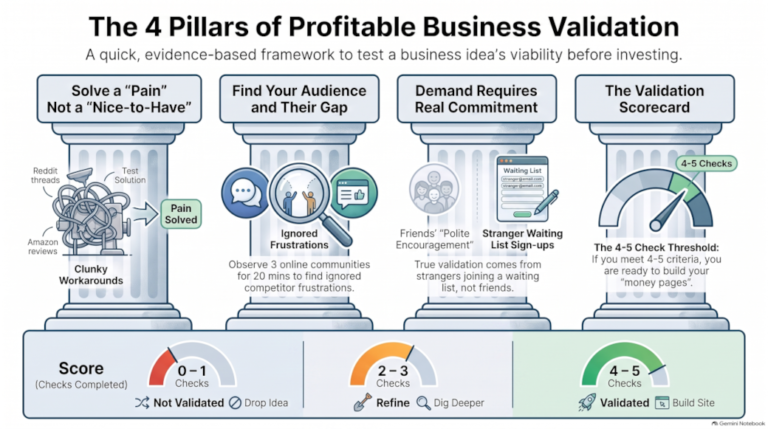
The 4 Pillars of Profitable Business Validation a quick, evidence-based framework for testing an idea before you build anything."

Check One: Is This a Real Problem?

There’s a difference between a “nice-to-have” and a problem people are actively trying to solve. Real problems already have evidence attached to them: people complaining, people searching for answers, people paying for imperfect workarounds.

Do this now: Write down the problem your idea solves in one sentence. Then write a second sentence describing what someone currently does about that problem even if it’s a clunky workaround, a spreadsheet, or just putting up with it.

If you can’t write that second sentence, that’s worth paying attention to. It doesn’t automatically mean the idea is dead, but it means you haven’t found evidence of the problem yet, only a hunch that it exists.

Where to actually look for that evidence:

  • Reddit and niche forums. Search the problem in plain, everyday language, not the polished way you’d describe it in a pitch.
  • Facebook Groups built around your topic or audience.
  • Amazon reviews of anything loosely related, especially the 3-star reviews. That’s where you’ll find “I like this, but I wish it also did…”
  • Google’s “People also ask” and autocomplete are the start of the problem; see what Google suggests finishing it with.

You’re not looking for people talking about your specific idea. You’re looking for people talking about the problem, in their own words, unprompted.

Check Two: Does an Audience Actually Exist?

Do this now: Pick three places your audience already gathers: a subreddit, a Facebook group, a hashtag, a forum. Spend twenty minutes reading real conversations there. Not searching for your idea, just observing what people are already frustrated about, asking for, or recommending to each other.

A few free ways to get a sense of scale:

  • Google Trends: Is interest in this topic flat, growing, or shrinking over time?
  • A free keyword tool: rough monthly search volume for the problem or solution
  • Simple counting: how many members are in that Facebook group, how active is that subreddit, how many replies does a typical thread get

By the end of this section, you should be able to describe your audience in one sentence: who they are, what they’re struggling with, and where they hang out online. That sentence is also the answer to the “Chosen a niche” step in your dashboard checklist this is where that box actually gets ticked, not by picking a category from a list, but by being able to describe a real group of real people.

Check Three: Who Else Is Already Solving This?

It’s tempting to treat competitors as bad news. They’re not. No competition at all is usually a red flag, not an opportunity it often means there’s no real market, not that you’ve found a gap nobody noticed.

Do this now: Find three competitors, direct or indirect. For each one, answer:

  • What do they charge?
  • What are people complaining about in their reviews?
  • What are they clearly not doing well?

You’re not looking to copy them. You’re looking for the gap the thing their customers keep asking for that isn’t being delivered. That gap is often exactly where your idea fits.

Check Four: Would People Actually Pay For It?

This is the hardest check, and the one people skip most often because it’s the one that can actually kill an idea you’ve grown attached to. Interest is not the same as willingness to pay. “That’s such a good idea!” from a friend means almost nothing. Real evidence looks different.

Do this now pick one of these:

  • Post about the problem in a relevant community and watch the reaction. Not likes comments asking “when can I buy this?” or “where do I sign up?”
  • Build a simple one-page “coming soon” landing page describing the solution, and see if anyone joins a waiting list.
  • Ask 5-10 people directly in your target audience whether they’d pay, and how much and be sceptical of a polite “yeah, I’d probably use that.”

The trap to watch for: friends and family telling you it’s a great idea. They’re not lying, but they’re also not your market, and their opinion costs them nothing. Strangers joining a waiting list, or strangers telling you they’d pay that’s the evidence that actually counts.

Validate Your Business Checklist Scorecard

validation-scorecard.yob247

Your Validation Scorecard

Go through this list honestly. Click each one you can genuinely say yes to.

Validation score 0%

4-5 checked: You’ve done the work. Move forward to choosing a domain and building your site.

2-3 checked: Don’t scrap the idea; refine it. Go back to whichever checks are unticked and dig a little deeper before building anything.

0-1 checked: This isn’t validated yet, and that’s completely fine. Better to find that out now, in an afternoon of research, than six months into building something nobody wanted.

What’s Next

Once your idea is validated, the next stage is choosing a domain, the first step in getting your site set up. 

And if you want to talk through your idea with people going through exactly this stage right now, that’s exactly what our community is there for.

Your Online Buisness
Privacy Overview

This website uses cookies so that we can provide you with the best user experience possible. Cookie information is stored in your browser and performs functions such as recognising you when you return to our website and helping our team to understand which sections of the website you find most interesting and useful.