Traffic sources come mostly from paid ads, social media channels, or organic content. You need to understand the different traffic sources to optimise your marketing efforts and allocate resources effectively to attract your target audience.

Traffic is the most vital part of your online business, and it’s easy to forget just how true that is until you’re staring at zero visitors. No traffic, no sales, no money. That sounds obvious, I know, but the frustration of doing everything else right- building a solid website, with good content, a real offer, and still not being found- is one of the most frustrating and demoralising parts of building an online business.

Most people’s instinct when this happens is to chase every traffic source at once: post on every social platform, dabble in ads, half-write a few SEO articles, and wonder why none of it seems to work. It rarely does. Traffic sources differ enough in cost, speed, and required skill that trying to do all of them badly usually beats doing one of them well.

That’s why this page isn’t a deep dive into any single traffic source. Traffic is too big a subject to cover properly in one place. Instead, this is your map: a brief, honest explanation of each major source, so you can decide where to focus first, with a link through to a full, detailed guide on each one.
Traffic-Sources
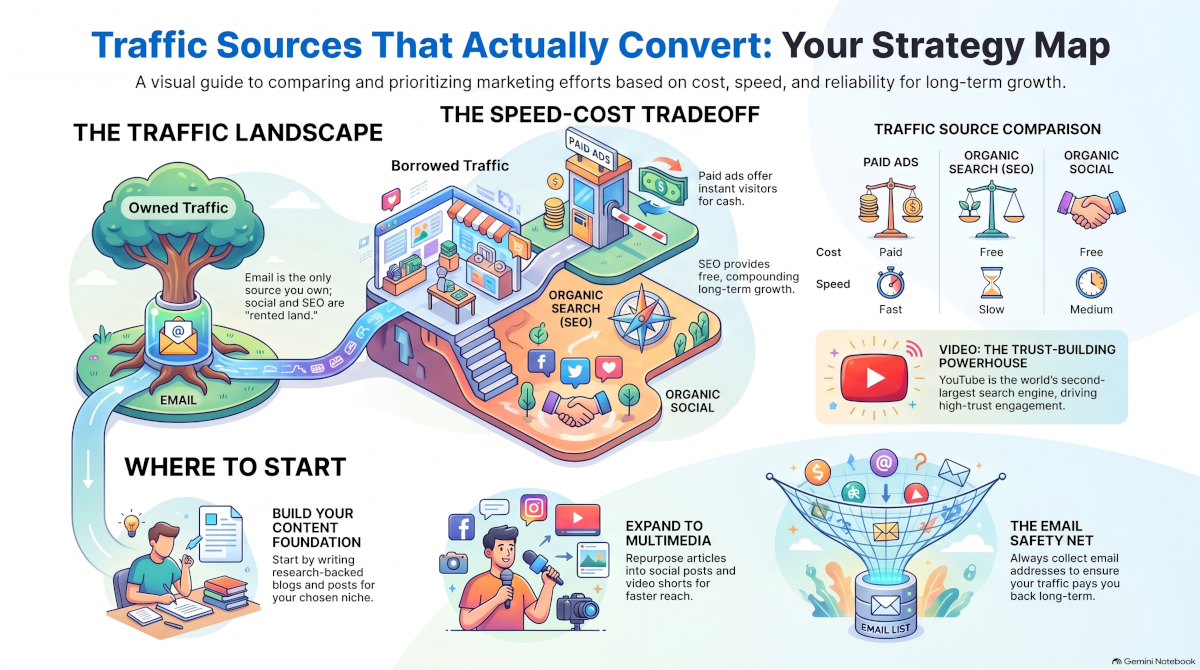
"Traffic Sources That Actually Convert: Your Strategy Map comparing cost, speed, and reliability across every major traffic source, and where to start."

Organic Search (SEO)

Traffic that finds you through Google and other search engines, without you paying for the click. In practice, this mostly means blogging and written content articles and guides written around the exact things your audience is searching for, which is how Google finds a reason to show your page in the first place.

It’s the slowest traffic source to build often months before you see meaningful results but once a page ranks, it can keep sending visitors for years with very little ongoing effort. This is the closest thing to “free, compounding traffic” that exists.

Cost: Free (but time-intensive) · Speed: Slow

Organic Social Media

Free reach built by posting directly on platforms like Instagram, TikTok, X, or Facebook. It can grow an audience faster than SEO in the early days, but you’re building on rented land a single algorithm change can quietly cut your reach overnight, and you don’t own the relationship the way you do with an email list.

Cost: Free (but time-intensive) · Speed: Medium

Video Marketing

Video gets its own category here rather than sitting under “social media,” because the platforms, skills, and strategy involved are genuinely different. YouTube is widely cited as the second-largest search engine in the world after Google itself, which is exactly why it behaves more like a search engine than a social feed.

Short-form video (Reels, TikTok, Shorts) has its own separate playbook entirely, on top of that. Done well, video is one of the most powerful trust-building traffic sources there is, because people are seeing and hearing you directly, not just reading your words.

It’s also worth going in with realistic expectations on cost decent equipment and editing (whether that’s your own time learning to edit, or paying someone else to do it) is a genuine investment, not a free channel the way organic social or SEO can be.

Cost: Requires investment (equipment and editing) · Speed: Medium

Email Marketing

Traffic you already own. Every other source on this page is borrowed a platform or search engine controls whether people see you. An email list doesn’t work that way: once someone subscribes, you can reach them directly, whenever you have something worth sharing. It’s rarely anyone’s first traffic source, but it’s usually the one that ages best.

Cost: Free (with a paid tool as your list grows) · Speed: Medium, but highly reliable

Referral & Backlinks

Traffic that arrives because another website linked to your website. This can be a mention in someone else’s article, a resource list, a partnership. Beyond the direct visitors, backlinks are also one of the strongest signals search engines use to decide how much to trust your site, so this source quietly supports your SEO traffic too.

Cost: Free to low-cost (usually earned, not bought) · Speed: Slow

Communities & Forums

Traffic from places like Reddit, niche forums, and community platforms such as Quora and Skool. (Skool has both free and paid communities). While most of these forums are free, they are time consuming.

But they are often the most overlooked source, and one of the most effective traffic sources when done correctly. The people there are usually already interested in your exact topic, which means the traffic tends to convert unusually well, as long as you show up to genuinely help rather than to just sell.

Cost: Mostly Free · Speed: Medium

Direct Traffic

People typing your URL straight into the browser, or using a saved bookmark. This one isn’t really a strategy you execute it’s a signal. Direct traffic tends to grow naturally as your brand becomes more recognisable through everything else you’re doing. If you see this number rising over time, it usually means the rest of your traffic strategy is working.

Cost: N/A (a byproduct, not a channel) · Speed: Slow to build, but a strong sign of progress

Paid Ads

Of all the traffic sources this is the quickest by far. Search ads, social ads, and display ads traffic you buy directly. The advantage is speed: you can have visitors within hours of launching a campaign, and you have far more control over exactly who sees your offer. The trade-off is it costs money.

But in the long run when done right, you bring visitors to your website, in which some will return. But the most critical part is to make sure you collect email address, because that will pay you back big time.

Cost: Paid, from day one · Speed: Fast

Where to Start

This is what your here to learn. You have to do things in a natural order. First write some content, blogs/posts, on your chosen niche. Having done your research. Then create media posts, from your article. Then some video shorts, and maybe a five to eight minute video for YouTube.

Video marketing is without doubt the fastest way to get traffic to your website, only paid traffic is faster. Just be consistent when it comes to creating content. Try and create something everyday, even if it’s only small, it all adds up.

Your Online Buisness
Privacy Overview

This website uses cookies so that we can provide you with the best user experience possible. Cookie information is stored in your browser and performs functions such as recognising you when you return to our website and helping our team to understand which sections of the website you find most interesting and useful.